Ahrefs is replacing Domain Rating with a new model called DR4, and it becomes the default score in the Ahrefs interface on 1 December 2026. Ahrefs previewed it on 5 November 2026, so you can already see your new number today.
Two things changed. DR is now calculated from a much smaller pool of sites — only those Ahrefs estimates get organic search traffic — and subdomains finally get their own score instead of inheriting the root domain’s rating.
That means some sites will wake up on 1 December with a lower DR without losing a single backlink, and a lot of “DR 70+” link sellers are about to look very different.
In this guide: exactly what changed, the numbers Ahrefs published, who gains and who loses, how to check your own DR4 score today, and the six checks to run on your backlink profile before the switch.
What is Ahrefs DR4?
DR4 is the fourth version of Domain Rating, the 0–100 logarithmic score Ahrefs uses to compare the strength of one site’s backlink profile with every other site in its index. The score itself is not new. What is new is which links are allowed to count toward it.
Under DR3, almost any domain in the Ahrefs index could pass link value. Under DR4, Ahrefs puts far more weight on links from sites and subdomains it estimates receive organic search traffic. The result is a smaller, cleaner pool of linking sites — Ahrefs says the number of sites with a DR4 score is about half the number that had a DR3 score.
The second change is subdomains. A blog on a free host used to inherit the rating of its root domain, so a throwaway page on a popular platform could show up as DR 90+. From DR4, each subdomain is scored on the links pointing to it alone.
| DR3 (old model) | DR4 (from 1 Dec 2026) | |
|---|---|---|
| Links that count | Nearly any indexed domain | Mainly sites estimated to have organic traffic |
| Size of the scoring pool | Full index | Roughly half as many hosts |
| Subdomains | Inherit the root domain’s DR | Scored on their own backlinks |
| Spam-labelled domains | Often still scored 30–70 | Median drop of about 15–20 points |
| Correlation with top-3 Google rankings, all hosts | 0.128 | 0.332 |
Data: Ahrefs DR4 announcement, 5 Nov 2026.
One thing DR4 did not change: Domain Rating is still a link metric only. It says nothing about your content, your brand or how Google judges your site. Google does not use Domain Rating. If you track both metrics, see Domain Rating vs Domain Authority.
DR4 timeline — the dates that matter
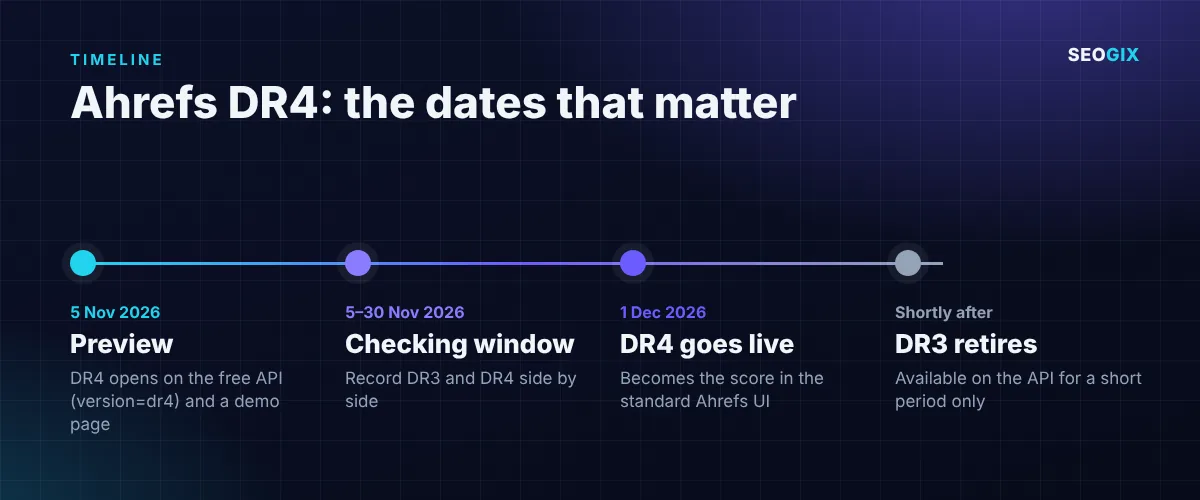
- 5 November 2026 — preview. Ahrefs published the DR4 announcement and opened the new score to everyone through the free Domain Rating API and a public demo page.
- 5 November to 30 November 2026 — the checking window. Both scores exist side by side. This is the only time you can record your DR3 and DR4 numbers together.
- 1 December 2026 — DR4 goes live. The new model becomes the default score in the standard Ahrefs interface. Check your Site Explorer numbers again after the switch.
- Shortly after 1 December — DR3 retires. Ahrefs says DR3 stays available through the API for a short period only, with no fixed end date announced.
How to see your DR4 score today. Call the free Domain Rating API endpoint and add the parameter version=dr4 to the request. Ahrefs also set up a public demo page where you can search any domain or subdomain. Do this before 1 December for your own site, your top 10 competitors and every site you have bought or earned a link from this year.
What actually changed in DR4
1. Only traffic-earning sites really count
DR has always been calculated from links. DR4 keeps that, but weights links from sites and subdomains that Ahrefs estimates earn organic search traffic. Sites with no measurable traffic lose most of their ability to pass authority, and the pool of sites carrying a DR4 score drops to about half the DR3 pool.
For link building, this is the whole story. A link from a site with real search traffic now moves your DR. A link from a quiet, no-traffic domain mostly does not.
2. Subdomains are scored on their own
This is the change that will surprise the most people. The examples Ahrefs published show how far a subdomain can fall once it stops borrowing its parent’s score.
| Subdomain | DR3 | DR4 | Change |
|---|---|---|---|
| help.ahrefs.com | 91 | 75 | −16 |
| play.google.com | 100 | 96 | −4 |
| blogs.microsoft.com | 96 | 89 | −7 |
| finance.yahoo.com | 94 | 92 | −2 |
| blogs.oracle.com | 93 | 86 | −7 |
| insights.samsung.com | 92 | 74 | −18 |
| A single site on a free hosting subdomain | 92 | 1.9 | −90.1 |
| A single page on a public publishing subdomain | 92 | 0 | −92 |
Source: Ahrefs DR4 announcement. Ahrefs notes these are real subdomains that link to Ahrefs, not an average for every subdomain on those platforms.
The last two rows are the ones to show a client. A page on a free hosting or publishing platform used to display DR 92. On its own links it is worth almost nothing. Many cheap “high DR” guest post and profile links sit on exactly this kind of host.
3. Spam-labelled domains fall hard
Ahrefs began flagging spam domains in 2025 and moved to a machine-learning model in January 2026. Spam domains that held DR3 scores between 30 and 70 lost a median of roughly 15–20 points under DR4. Non-spam domains stayed close to flat across most DR ranges.
4. DR4 tracks Google rankings more closely
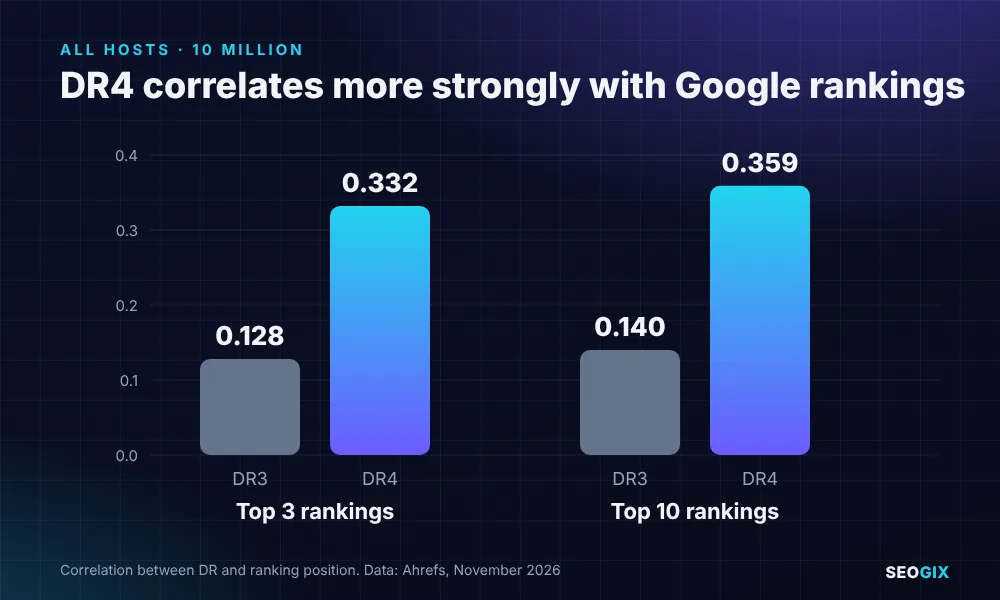
Across 10 million hosts, Ahrefs measured the correlation between DR and Google ranking positions under both models.
| Subset | Sample | Top 3 vs DR3 | Top 3 vs DR4 | Top 10 vs DR3 | Top 10 vs DR4 |
|---|---|---|---|---|---|
| All hosts | 10,000,000 | 0.128 | 0.332 | 0.140 | 0.359 |
| Root domains | 5,231,436 | 0.382 | 0.295 | 0.407 | 0.304 |
| Subdomains | 4,768,564 | 0.126 | 0.225 | 0.172 | 0.259 |
Source: Ahrefs DR4 announcement.
Read the table carefully, because the second row is easy to miss. Across all hosts, DR4 correlates more than 2.5 times more strongly with top-3 rankings. For root domains only, DR3 was actually the better fit, because DR3 was built around root domains. Correlation is also not causation — it shows a pattern, not a ranking factor.
Winners and losers under DR4
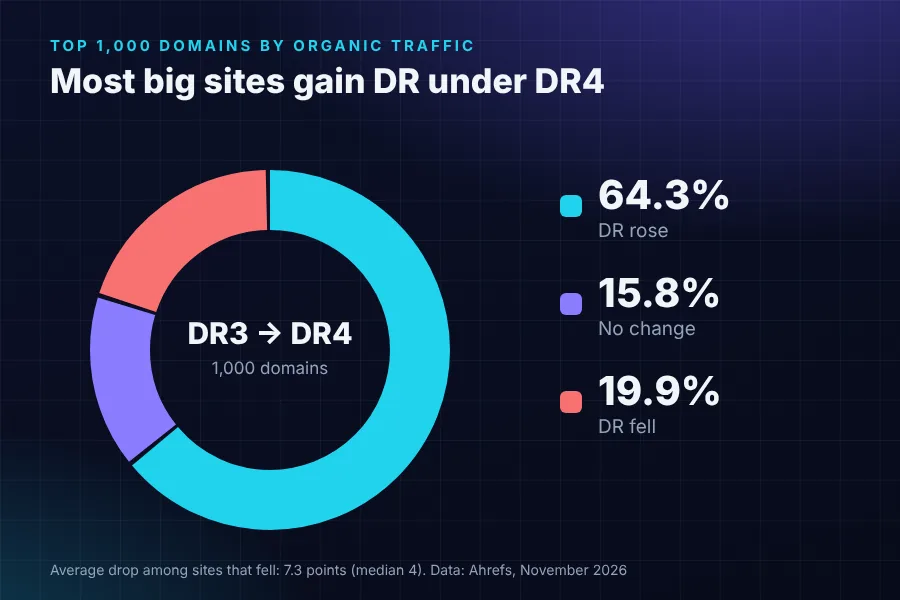
Most big sites gain. Ahrefs compared its top 1,000 domains by estimated organic traffic under both models: 64.3% saw DR rise, 15.8% stayed the same, and 19.9% saw it fall. Among the sites that fell, the average drop was 7.3 points and the median was 4.
Likely to gain
- Sites with steady organic traffic and links from other traffic-earning sites.
- Digital PR and news placements. A study of 222 outlets PR teams pitch found 139 scoring DR 90+ under DR4, up from 107.
- Niche sites whose links come from real blogs rather than networks.
Likely to lose
- Sites built on cheap “high DR” guest posts and profile links from no-traffic domains.
- Anything on a free hosting or publishing subdomain, where scores can collapse to near zero.
- Domains carrying the Ahrefs spam label, down a median 15–20 points in the DR3 30–70 band.
- Large platform domains used for free hosting. github.io fell about 32 points, while a real site on it, facebook.github.io, still holds DR 86.
The pattern is consistent: DR4 does not punish sites, it stops counting links that never had an audience. If your DR drops, it is telling you something about the links pointing at you, not about your content.
Will my Domain Rating drop on 1 December?
You do not have to guess. Check your DR4 score now through the free Ahrefs Domain Rating API with version=dr4, or on the public demo page, and compare it with the DR3 number still showing in Site Explorer.
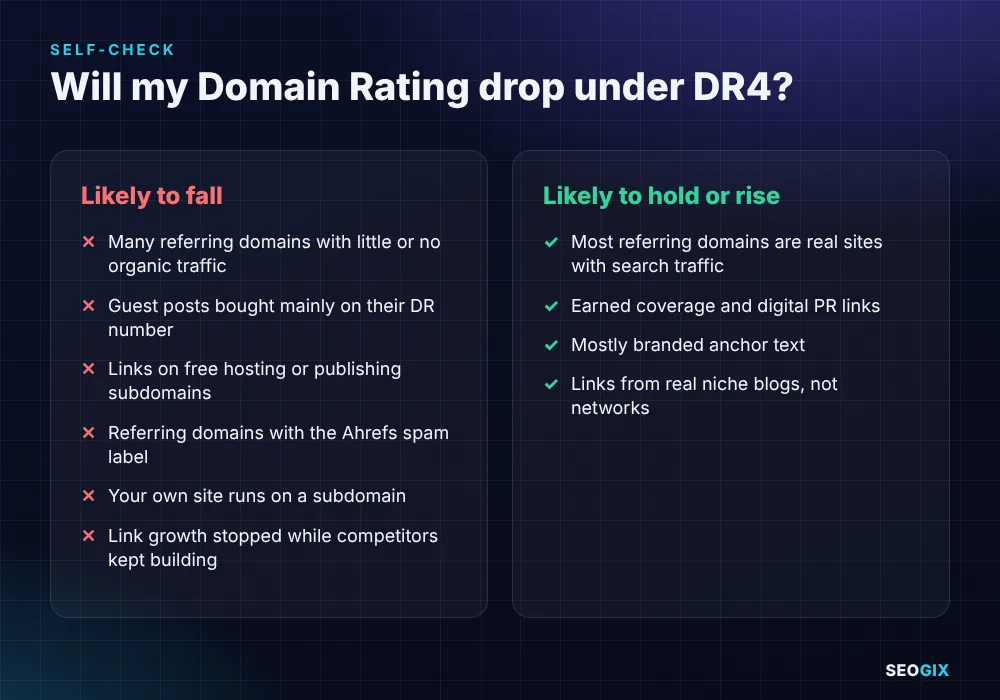
Your DR is more likely to fall if any of these describe your backlink profile:
- A large share of your referring domains have little or no organic traffic.
- You bought guest posts or niche edits priced mainly on their DR number.
- Many of your links sit on subdomains of free hosting, blogging or publishing platforms.
- Some of your referring domains carry the Ahrefs spam label.
- Your own site runs on a subdomain rather than a root domain.
- Your link growth stopped more than a year ago while competitors kept building.
Your DR is more likely to hold or rise if most of your referring domains are real sites with visible search traffic, you have earned coverage or digital PR links, and your anchor profile is mostly branded.
One caution for agencies and freelancers: if you report DR to clients every month, a 4 to 10 point move on 1 December will look like something went wrong. Record both scores for every client before 30 November, and add one line to the December report explaining the model change. A drop you explained in advance is a conversation. A drop you explain afterwards is an argument.
What to do before 1 December 2026
Six checks, in order. The first three are time-sensitive, because once DR3 leaves the API you cannot recreate the comparison.
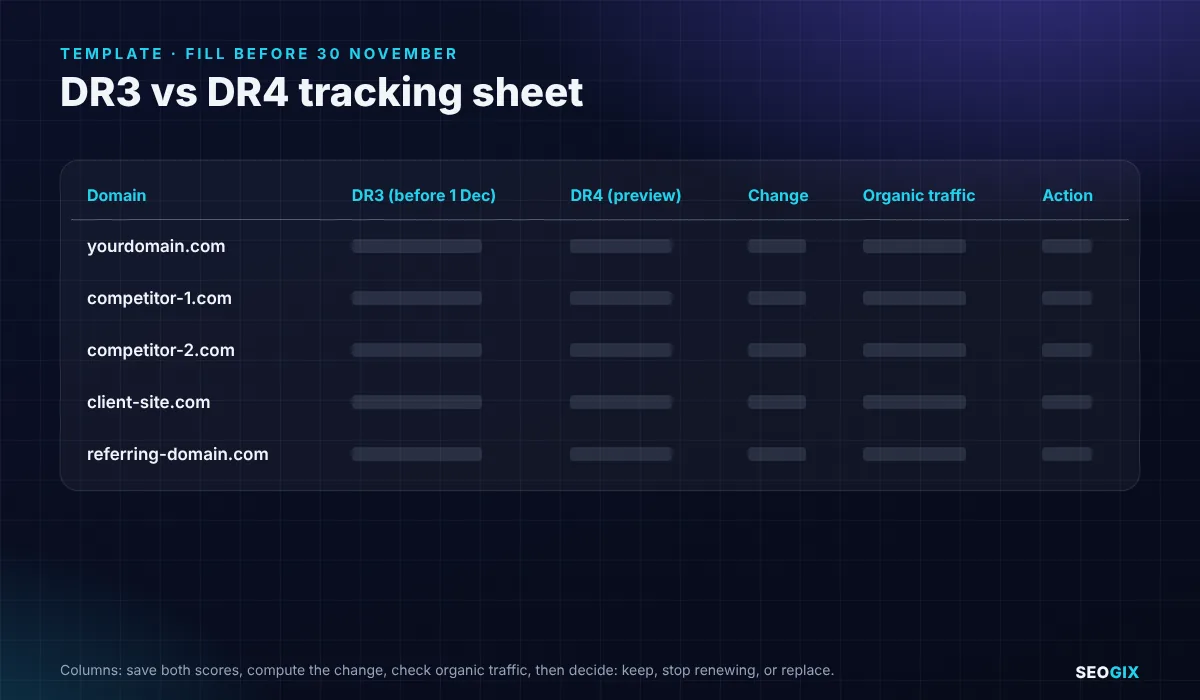
- Save both scores. Export DR3 and DR4 for your site, your five closest competitors and every client you report on. Put them in one sheet with today’s date. This becomes your baseline for the December report.
- Re-score your referring domains. Pull your referring domains report, run the top 100 through the free DR4 API, and sort by the change column. Anything that falls by more than 20 points was never the link you thought you bought.
- Audit links you paid for in the last 12 months. Flag every placement on a subdomain and every domain with no organic traffic. Stop renewing those.
- Rebuild your prospecting filter. Replace “DR 50+” with three conditions: a DR4 score, estimated organic traffic above zero and rising, and topical relevance to your page. DR alone was never a good filter and it is a worse one now.
- Warn clients in writing. One short email before 30 November: the model is changing, scores may move a few points either way, nothing is wrong with the site, here are your before and after numbers.
- Shift budget toward traffic-earning placements. Digital PR, real niche blogs, resource pages and link reclamation all survive DR4 intact. Bulk packages priced by DR number do not.
What DR4 means if you buy backlinks
Most link packages sold in the last two years were priced on one number: DR. From 1 December that number is measured differently, and a share of the inventory sold as DR 70+ will be worth a fraction of what the invoice said.
Four checks before you pay for any placement, now:
| Check | What to look for | Why it matters under DR4 |
|---|---|---|
| Organic traffic | Steady or rising estimated traffic, not a flat line | Traffic-earning hosts are the ones that still pass authority |
| Root domain or subdomain | The exact URL the link will sit on | A subdomain is now scored on its own links, not its parent’s |
| Spam label | Check the domain in Ahrefs before buying | Spam-labelled domains in the 30–70 band lost a median 15–20 points |
| DR4 score, not DR3 | Ask the seller for the version=dr4 number | A DR3 screenshot from October proves nothing in December |
If a seller cannot show you traffic, or quotes a DR number without saying which model it came from, that is your answer.
At SEOGIX we only place links on traffic-verified sites, and every site in a proposal is checked on both DR3 and DR4 before it reaches you. If you are holding an invoice for links you are no longer sure about, get a free backlink audit and we will show you the before and after numbers for your own profile. You can also see how we build high DR backlinks that survive a model change.
Frequently asked questions
When does Ahrefs DR4 go live?
DR4 becomes the default score in the standard Ahrefs interface on 1 December 2026. It was previewed on 5 November 2026, and DR3 scores remain available through the Ahrefs API for a short period after the switch.
Will my Domain Rating drop with DR4?
It can, without you losing a single link. Among the top 1,000 domains by organic traffic, 64.3% gained DR, 15.8% stayed flat and 19.9% dropped, with an average decrease of 7.3 points. Sites relying on no-traffic links see the biggest falls.
Is a DR drop a Google penalty?
No. Domain Rating is an Ahrefs metric, not a Google one. Google does not use DR and has never confirmed any equivalent public score. A DR4 drop changes nothing about your rankings, your traffic or your site’s quality.
How do I check my DR4 score before December?
Use the free Ahrefs Domain Rating API endpoint and add version=dr4 to the request, or search your domain on the public demo page Ahrefs published with the announcement. Both work for subdomains as well as root domains.
What is the difference between DR3 and DR4?
DR4 weights links from sites estimated to have organic search traffic, which halves the pool of sites that can pass authority, and it scores every subdomain on its own backlinks instead of letting it inherit the root domain’s rating.
Do my old high DR backlinks still work?
Links from real, traffic-earning sites keep their value. Links from no-traffic domains, spam-labelled sites and free-hosting subdomains lose most of their DR contribution. Their effect on Google was always separate from DR, and that has not changed either.
Should I stop tracking Domain Rating?
No, but stop treating it as a goal. Use DR4 for link prospecting and competitor comparison. Judge your SEO on rankings, organic traffic and conversions, which are the numbers that pay you.
The takeaway
DR4 is not a punishment and it is not a Google update. It is Ahrefs tightening a link metric so that it reflects sites people actually visit. If your DR falls on 1 December, the model changed, not your site.
The practical move is the same whether you gain or lose: record both scores before 30 November, re-check the domains you have been buying links from, and start judging a link by its traffic and relevance rather than by a two-digit number. If you need to rebuild, here is how to increase your Domain Rating with links that last.
Want to know where your backlink profile stands under the new model? Request a free SEOGIX backlink audit and we will send you your DR3 and DR4 comparison, the referring domains that are about to lose value, and what to do about them.