
The Short Answer
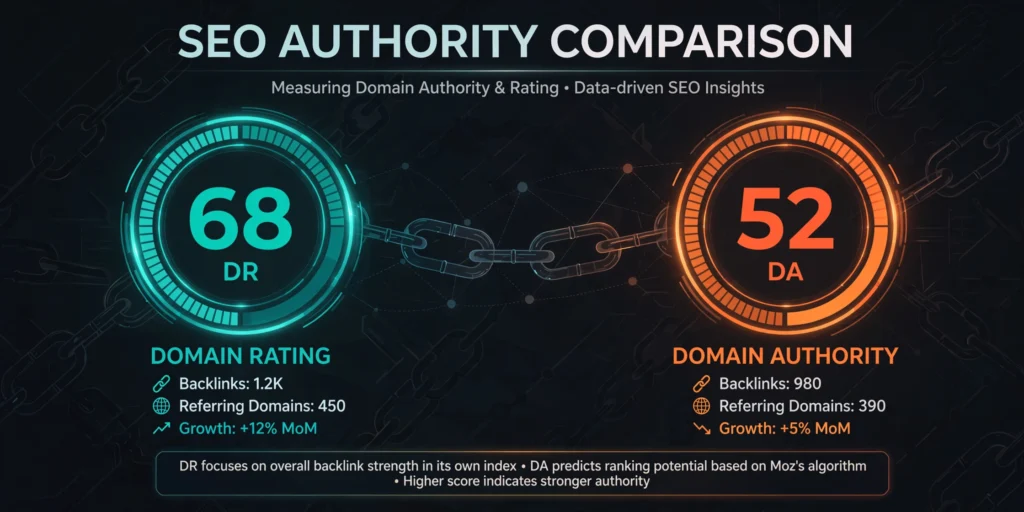
Domain Rating (DR) is Ahrefs’ 0–100 score for backlink-profile strength. Domain Authority (DA) is Moz’s 0–100 score for the same idea — how likely a domain is to rank, based on its link profile. They measure similar things with different formulas, different link indexes, and different scales. You cannot compare them directly: a DR 45 is not “better” or “worse” than a DA 45. They’re different rulers.
How Ahrefs Builds DR (in 60 Seconds)
DR is refreshingly straightforward about what it measures: the strength of your backlink profile, full stop. Ahrefs counts dofollow referring domains, weights them by how authoritative each linking domain is, and discounts domains that link out to thousands of sites. The scale is logarithmic — climbing from 70 to 75 takes vastly more link power than climbing from 20 to 25. New to the metric entirely? Start with our What Is Domain Rating guide first.
How Moz Builds DA (in 60 Seconds)
DA is more of a prediction than a measurement. Moz feeds its link data — linking root domains, total links, and quality signals — into a machine-learning model trained against actual search results, and DA is the model’s estimate of how likely the domain is to rank. Moz also folds in spam signals, which is why a site with a dirty link profile can show a surprisingly low DA even with plenty of backlinks. Like DR, the scale is logarithmic and 0–100.
The key philosophical difference: DR asks “how strong are your backlinks?” while DA asks “how likely are you to rank?” In practice they usually agree — strong backlinks predict rankings well — but they can diverge sharply on edge cases like penalized sites or fresh domains with a few great links.
DR vs DA: Side by Side
- Who makes it: DR → Ahrefs · DA → Moz
- Scale: both 0–100, both logarithmic (higher points are exponentially harder)
- What it measures: DR weights the strength of linking domains heavily · DA blends link data with more ranking-prediction signals
- Spam handling: DR mostly ignores link quality context · DA explicitly factors spam signals into the score
- Update speed: both update on the tool’s own crawl schedule, not in real time
- What Google thinks: neither is a Google ranking factor — Google has its own internal signals
Why the Numbers Disagree on the Same Site
It is completely normal for a site to be DR 38 and DA 24 — or the reverse. The two tools crawl different portions of the web, count links differently, and apply different math. Neither is “wrong”; they’re just different estimates. This is also why you should always compare a site against itself over time, or against competitors within the same metric — never mix DR and DA in one comparison.
The biggest gaps appear in three situations: new sites (one crawler found the links before the other), sites with spammy histories (Moz’s spam signals drag DA down while DR stays high), and niche/regional sites (crawler coverage varies by language and region). If you see DR 50 and DA 18 on the same domain, don’t average them — investigate the spam signals.
5 Myths About DR and DA
Myth 1: “DR 50 equals DA 50.”
No. The scales were built independently. A DR 50 and a DA 50 describe completely different levels of authority — treat every cross-metric comparison as meaningless.
Myth 2: “Higher DA always outranks lower DA.”
DA predicts ranking likelihood across the whole domain, not the outcome of any single keyword battle. Relevance, content depth and intent match routinely let lower-DA pages win.
Myth 3: “Google uses DA/DR in its algorithm.”
Google engineers have said repeatedly they don’t use third-party metrics. These scores correlate with rankings because they measure backlinks — which Google does use — not because Google reads the scores.
Myth 4: “DA updates daily, so I can watch it move.”
Both metrics move on crawler schedules over days to weeks. Checking daily is watching paint dry; check monthly.
Myth 5: “A high DA/DR site is automatically a safe link target.”
Manipulated metrics are a whole industry. Always cross-check with organic traffic — a “DR 60” site with zero traffic is a warning sign, not an opportunity.
Which One Should You Care About?
Honestly? Whichever one your industry checks. In practice:
- Link sellers and buyers quote DR far more often — it’s the lingua franca of the link market.
- SEOs doing competitive analysis often use DA alongside Moz’s spam score for quick vetting.
- Site acquirers look at both, plus traffic, before making offers.
If you sell links or buy them, DR is the number you’ll hear daily. If you do general SEO audits, track both. Our free authority checkers show DR, DA/PA and Trust Flow together so you can see the full picture in one place.
Which Should You Track Monthly?
Pick one primary metric tied to your goal and check it monthly — not daily. Buying or selling links? Track DR. Running general SEO audits? Track DA with spam score. Then add the one metric that actually pays bills: organic traffic. A rising metric with flat traffic means you’re optimizing a scoreboard; rising traffic with a flat metric means the scoreboard is lagging reality. Either way, the trend over 3–6 months is the truth — single readings are noise.
Can You Increase Both at Once?
Yes — because both reward the same thing: real backlinks from strong, trusted domains. A manual outreach campaign that earns links from authoritative sites will lift DR and DA together (on their own timelines). There is no separate “DA strategy” vs “DR strategy” — there is only good link building vs bad link building.
Good link building means: real websites with real traffic, niche relevance, editorial placements, and verifiable reports. Bad link building means PBNs, link farms, and footer spam — which can inflate either metric temporarily before it collapses. For a step-by-step playbook on the Moz side, see our how to increase Domain Authority guide.
Which Service Do You Need?
- Want the Ahrefs number up? Our Increase Domain Rating service builds manual links from DR 50+, 60+ and 70+ domains — from $50/link.
- Want the Moz number up? See our High DA backlinks inventory.
- Want overall authority? Start with our link building inventories by niche and region.
Quick FAQ
Is DR or DA more accurate?
Neither is “accurate” — both are estimates from different crawlers. Accuracy isn’t the right question; consistency is. Pick one and track its trend.
Why is my DA stuck while my DR climbs?
Usually crawler timing — Moz hasn’t processed your new links yet — or spam signals holding DA back. Give it one full index cycle (several weeks) before worrying.
Do I need to pay for Ahrefs or Moz to track these?
No. Our free checkers show DR, DA/PA and Trust Flow without a subscription.
The Bottom Line
DR and DA are two dialects of the same language: backlink strength. Learn what each one is telling you, stop comparing across metrics, and put your energy into earning links that move both — real placements on real sites. The numbers follow the work, not the other way around.