
First, the Honest Truth
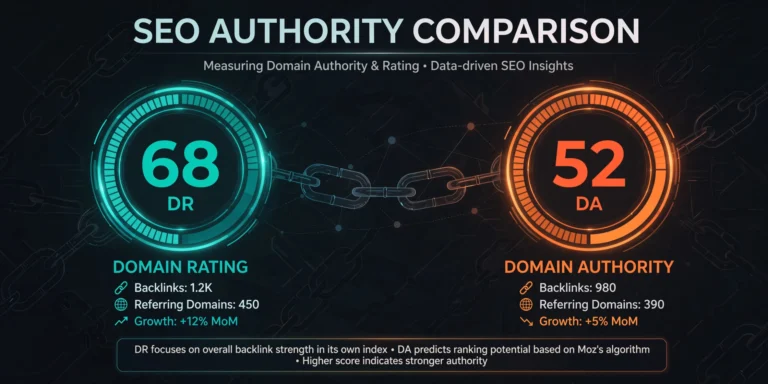
Domain Authority (DA) is Moz’s 0–100 prediction of how well a domain can rank, based on its backlink profile. You raise it the same way you raise any authority metric: earn backlinks from strong, trusted websites. There is no trick, no plugin, and no 24-hour hack — anyone selling you one is selling inflated numbers that collapse. What follows are the methods that actually work, in order of impact.
Step 0: Know Your Starting Point
Before building anything, take a baseline snapshot — otherwise you’ll never know what worked. Write down four numbers: your DA, your Moz spam score, your referring domains count, and your monthly organic traffic. Our free authority checkers give you DA, DR and Trust Flow in seconds. The spam score matters more than beginners think: a site with DA 25 and 2% spam score is healthier than DA 35 with 40% spam — and the second one needs cleanup before building.
1. Earn Links From High-DA Sites (the Biggest Lever)
DA is logarithmic: one link from a DA 80 site moves you more than fifty links from DA 15 sites. Prioritize placements on genuinely authoritative domains — real publications, established blogs, industry resources. Manual outreach beats every shortcut here. Our High DA backlinks inventory exists for exactly this: vetted placements on DA 50+ domains.
How to vet a target yourself: check that the site has real organic traffic (a high-DA site with zero traffic is a red flag), publishes regularly, and isn’t openly selling hundreds of guest posts. One editorial link from a respected industry site will do more for your DA — and your rankings — than a year of directory submissions.
2. Guest Post on Real Blogs in Your Niche
Guest posting remains one of the safest, most effective authority builders — when the blogs are real. Look for sites with genuine organic traffic, recent content, and an actual audience. A single guest post on a respected industry blog beats ten posts on dead “write for us” farms. See our guest posting service if you want this done for you.
Make your pitch impossible to ignore: reference a specific article they published, propose 2–3 concrete headlines tailored to their audience, and include one writing sample. Site owners delete 95% of generic “I want to contribute” emails — specificity is the whole game. And always negotiate an in-content dofollow link, not an author-bio link buried at the bottom.
3. Create Linkable Assets
The pages that earn links while you sleep: original research, free tools, definitive guides, useful templates. A single good tool or study can earn dozens of backlinks over years with zero ongoing effort. This is compound interest for DA — slow to start, unstoppable once rolling.
What actually earns links in practice: original data (survey your niche and publish the results — journalists cite numbers), free tools (calculators, checkers, generators — our own free SEO tools exist partly for this reason), and definitive statistics roundups that become the page everyone references. After publishing, spend as much effort promoting the asset as creating it — email 20 relevant site owners personally. Assets without outreach are lottery tickets.
4. Reclaim Lost and Broken Links
Some of the cheapest authority you’ll ever gain is already yours. Check for: backlinks pointing to 404 pages on your site (redirect them), unlinked brand mentions (ask for the link), and links you lost when pages changed (reach out and restore). Every reclaimed link is DA you already earned once.
Do this quarterly: export your backlink profile, filter for links pointing to 404s, and 301-redirect each dead URL to its closest live equivalent. Then search Google for your brand name minus your domain — every mention without a link is an email asking for one. Site owners say yes surprisingly often, because linking the mention is obviously correct. This single habit recovers authority most sites are silently leaking.
5. Fix Your Technical Foundation
Authority can’t flow through a broken site. Make sure link equity actually reaches your pages: fix crawl errors, use clean internal linking so authority flows to money pages, keep the site fast, and make sure you’re on HTTPS. Our technical SEO service covers the full audit if you’d rather not DIY it.
The three technical issues that silently cap DA growth: orphan pages (great content with no internal links pointing to it — link equity can’t reach what it can’t find), redirect chains (each hop leaks equity; keep chains to a single 301), and accidental noindex tags left over from staging. A one-hour technical pass often unlocks authority your backlinks already earned.
6. Disavow Toxic Links (Carefully)
A profile full of spam links drags down trust. If you have clearly manipulative backlinks — hacked-site injections, foreign-language spam networks, obvious paid link schemes — a careful disavow can help. But don’t disavow aggressively: most small sites are better off building good links than pruning mediocre ones. When in doubt, get a professional backlink check first.
Disavow only what is unambiguously toxic: large-scale automated spam, links from penalized networks, and injections you didn’t create. Never disavow a link just because its DA is low — small legitimate sites are not toxic, they’re just small. And after submitting a disavow file, wait a full index cycle before judging; Moz needs to recrawl before the score reflects the cleanup.
7. Be Consistent — Authority Compounds
The sites with DA 60+ didn’t get there in a quarter. They published, outreached, and earned links for years. Set a sustainable pace — a few quality placements per month beats a frantic burst followed by silence. Search engines (and Moz’s model) reward steady, natural-looking growth.
Make it a system, not a campaign: two outreach emails per week, one linkable asset per quarter, one reclamation pass per quarter. Boring? Yes. Effective? Completely. The sites that win are the ones still building links in month 18 when everyone else quit in month 3.
8. Digital PR: The Fast Lane
If guest posting is the steady road, digital PR is the highway. Journalists constantly need expert quotes, fresh data and commentary — give it to them and the links come from DA 70+ news domains you could never buy. Watch journalist-request platforms, respond within hours (speed wins), and give quotable, opinionated answers — “it depends” never gets published.
Even three successful placements a year on genuine news sites can move DA more than fifty low-tier guest posts. Start small: one data-led story per quarter built from your own experience or customer data. “We analyzed 500 client sites and found X” is a headline journalists can use — and link.
9. Internal Linking: The Forgotten Lever
Everyone chases external links while ignoring the equity already inside their site. Your homepage usually holds your strongest link profile — point it where it matters. Audit which pages earn revenue and check how many clicks deep they sit from the homepage; anything important buried four clicks down is starving. Add contextual in-content links (not just nav links) from high-authority pages to the pages you want to rank, using descriptive anchor text. This doesn’t raise DA directly — DA is domain-level — but it converts your domain’s authority into actual rankings, which is the point of the whole exercise.
How Long Does It Take?
Moz updates DA on its own index refresh cycle. Expect 4–12 weeks before new links fully reflect in your score, and meaningful DA movement typically takes 3–6 months of consistent building. Track the trend, not the daily number.
Set honest milestones: months 1–2 are foundation (baseline, cleanup, first outreach), months 3–4 are when early links land in the index, months 5–6 are when the trend becomes undeniable. Anyone promising “DA 50 in 30 days” is selling you the inflated-number trick — real authority has a speed limit.
How to Measure Progress (Without Obsessing)
Check monthly, same tool, same day. Record DA, spam score, referring domains and organic traffic in a simple sheet. Judge the 3-month trend, never a single reading. Healthy progress looks like: referring domains climbing steadily, spam score flat or falling, traffic rising — even if DA itself moves slowly. If DA is flat but referring domains and traffic grow, you’re winning and the metric is just lagging. If DA rises but traffic is flat, you’re optimizing a scoreboard instead of a business — refocus on relevance and content.
What NOT to Do
- Don’t buy PBN links — inflated DA that vanishes on the next index update, sometimes with a penalty attached.
- Don’t chase DA in isolation — a high-DA site with no traffic or relevance is a vanity metric, not a business asset.
- Don’t obsess over the number weekly — check monthly, focus energy on earning links.
- Don’t buy “DA 50+ guaranteed” packages — the guarantee is the tell. Real outreach can’t guarantee a metric; only manipulation can.
- Don’t ignore relevance — fifty links from unrelated niches look manufactured. Ten links from your own industry look earned.
Quick FAQ
Can DA go down?
Yes — lost backlinks, Moz index recalculations, or a rising spam ratio can all drag it down. Small dips are normal noise.
What’s more important: DA or referring domains?
Referring domains. It’s the raw fuel; DA is the dashboard gauge. Track both, optimize the fuel.
Does Moz count nofollow links for DA?
Moz’s model weighs link signals broadly, but dofollow editorial links remain the primary driver. A natural profile has both — don’t fear nofollow, just don’t build a strategy on it.
The Bottom Line
Increasing Domain Authority comes down to one boring truth: earn good links, consistently, from real websites. Do that for six months and the metric takes care of itself. And if you want a head start, browse our link inventories or message us on WhatsApp for an honest read on your site’s link profile. Still mixing up the metrics? Our DR vs DA guide clears it up.