
Domain Rating in One Paragraph
Domain Rating (DR) is Ahrefs’ 0–100 score for how strong a website’s backlink profile is. The more high-quality websites link to you — especially websites that are themselves authoritative — the higher your DR climbs. It is one of the most-checked numbers in SEO: before anyone buys a link, a guest post, or even a whole website, they look at DR first.
Here is the honest part most sellers skip: DR is not a Google ranking factor. Google’s algorithm does not read your Ahrefs DR. But the same strong backlinks that raise DR are the foundation rankings are built on — so while the number itself doesn’t rank you, what it measures absolutely matters.
How Ahrefs Calculates Domain Rating
Ahrefs looks at the quantity and quality of unique domains linking to your site. Three things matter most:
- How many unique domains link to you — 100 links from 100 different sites beat 100 links from one site.
- How strong those linking domains are — a link from a DR 80 news site moves your DR far more than a link from a DR 10 blog.
- How many other sites those domains link to — a link from a page that links out to 5 sites passes more value than one linking to 5,000.
Crucially, the scale is logarithmic, not linear. Going from DR 20 to DR 30 takes far less authority than going from DR 60 to DR 70. Each point at the top requires links from a shrinking pool of genuinely powerful domains — which is also why high-DR placements cost more.
One detail that surprises people: Ahrefs bases DR on dofollow referring domains. A hundred nofollow links from blog comments won’t move your DR at all — which is exactly why serious link building chases editorial, dofollow placements.
Domain Rating vs URL Rating: Don’t Mix Them Up
Ahrefs has two similarly-named scores and beginners constantly confuse them. Domain Rating (DR) measures the strength of your entire domain’s backlink profile. URL Rating (UR) measures the strength of a single page’s backlinks. A DR 70 news site can easily have individual articles sitting at UR 10 — because authority lives at the domain level, but rankings happen at the page level.
Why does this matter to you? Two reasons. First, when you buy a link placement, check both: a DR 65 site is great, but if your link lands on a brand-new page with UR 0 and no internal links pointing to it, that placement carries far less weight than the domain’s DR suggests. Second, when diagnosing why a page doesn’t rank, UR tells you more than DR — it shows the actual link strength behind that specific URL. Smart buyers check the domain’s DR and the page’s UR before paying.
What Is a Good Domain Rating?
Context matters more than the raw number:
- DR 0–20: New or small sites. Normal starting point — everyone begins here.
- DR 30–50: Established sites with real link-building history. Taken seriously by most partners.
- DR 50–70: Strong authority. You clear most guest-post minimums and look credible to buyers.
- DR 70+: Elite territory — major publications, big brands, household names.
Don’t chase someone else’s number. A local business outranking competitors at DR 25 doesn’t need DR 70 — it needs to beat the sites on page one of its own SERPs.
Why Your DR Suddenly Dropped
DR going down is more common than people admit, and it rarely means you did something wrong. The usual causes:
- Lost referring domains — sites that linked to you deleted pages, removed your link, or went offline. Check Ahrefs Site Explorer → Backlinks → Lost to see exactly what disappeared.
- Ahrefs recalculated its index — when Ahrefs updates how it crawls or counts links, scores across thousands of sites shift at once. If your links didn’t change but DR moved, this is usually why.
- Linking domains lost authority themselves — DR is relative. If several sites linking to you dropped in DR, yours follows.
- Redirects broke — a changed URL structure without proper 301s can orphan the backlinks pointing at old URLs.
Don’t panic over a 2–3 point dip — that is normal noise. Investigate when you lose 5+ points: find the lost links first, because reclaiming them is the fastest recovery you’ll ever get.
Why Everyone Checks DR Before Doing Business With You
Three groups check your DR before the conversation even starts:
- Clients vetting an agency or freelancer look at the DR of sites in the portfolio.
- Buyers evaluating a website for acquisition treat DR as a quick proxy for backlink-asset value.
- Site owners set minimum DR thresholds before accepting guest posts or partnerships.
A low DR closes doors quietly. Nobody emails you to say “your DR was too low” — they just never reply.
Inflated DR: The Number Some Sellers Fake
Here is the dark side nobody in the link market wants to discuss: DR can be manipulated, and inflated DR is everywhere. The common tricks:
- Expired domains with leftover authority — a dead site with historic links gets revived, shows DR 50+, but has zero traffic and zero relevance.
- Link-farm blasts — thousands of spammy links pumped at a domain spike its DR for a few weeks before collapsing.
- 301 redirect chains — authority from an old domain gets funneled into a new one, creating a DR number the site never earned.
How to spot it: compare DR against organic traffic. A genuine DR 55 site almost always has meaningful search traffic. A “DR 55” site with zero organic traffic is a billboard in the desert — the number is hollow. Also check the referring-domains graph in Ahrefs: a sudden vertical spike followed by flatline screams manipulation, while steady growth looks like real link building. This is why honest sellers show you the actual placements before you pay — if a seller hides the URLs, walk away.
How to Increase Your Domain Rating
DR moves when authoritative domains link to you. The legitimate ways to make that happen:
- Manual outreach and guest posting on real sites in your niche — slow, but the links stick.
- Digital PR — original data, studies, or tools that journalists actually want to cite.
- Linkable assets — free tools, calculators, and definitive guides earn links passively over time.
- Fixing lost links — reclaiming broken or removed backlinks is the cheapest DR you’ll ever gain.
What doesn’t work long-term: PBN links and spam networks. They can spike DR for a few weeks, then collapse — sometimes taking your rankings with them.
If you’d rather have it done for you, our Increase Domain Rating service builds manual backlinks from real DR 50+, 60+ and 70+ domains — from $50/link, with a 3-month guarantee and every placement verifiable in Ahrefs.
How to Check Your Domain Rating for Free
You don’t need a paid Ahrefs subscription to see your DR. Our free authority checkers show your DR, DA/PA and Trust Flow in seconds — no signup, no catch. Check monthly, write the number down, and watch the trend. The trend is the truth; any single reading is just a snapshot.
Does a Higher DR Mean Higher Google Rankings?
Not directly — and this is where most people get confused. Google has never used Ahrefs DR; it uses its own internal signals. But across thousands of sites, higher DR correlates strongly with better rankings, because the same backlinks that raise DR are what Google actually rewards. Think of DR as a thermometer: it doesn’t cause the fever, but it tells you the temperature.
The practical takeaway: a DR 30 site with sharp content and perfect relevance can absolutely outrank a DR 60 site on a specific keyword. DR tells you who has the stronger overall link profile — relevance, content quality and intent match decide individual battles. Build links for rankings and traffic first; treat DR as the scoreboard, not the game.
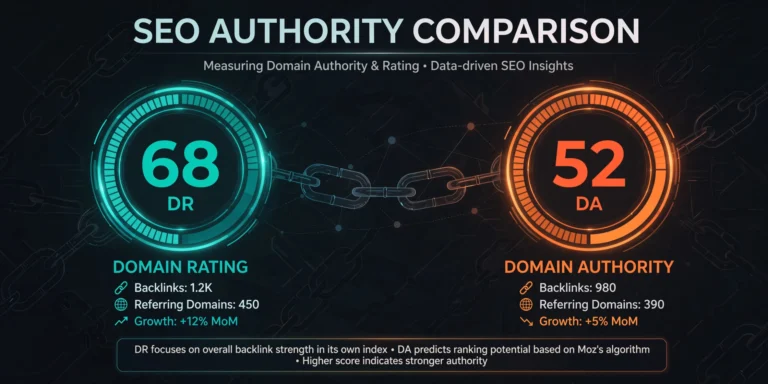
Confused about how DR compares to Moz’s equivalent? Read our Domain Rating vs Domain Authority breakdown.
How Long Does It Take?
Ahrefs recalculates DR on its own crawl schedule, not in real time. Links going live today typically start showing in your score within 1–4 weeks. A full campaign usually needs 4–12 weeks for the complete movement — allow up to 3 months before judging the result. Anyone promising overnight DR jumps is selling inflated numbers.
Quick FAQ
Can Domain Rating decrease?
Yes. Lost backlinks, Ahrefs index recalculations, or linking domains losing authority can all pull your DR down. Small fluctuations are normal noise.
How often does Ahrefs update DR?
Continuously as its crawler discovers and re-evaluates links — but visible score changes typically appear over days to weeks, not instantly.
Is DR 0 bad?
No — every site starts at 0. It simply means Ahrefs hasn’t found qualifying referring domains yet. New sites should focus on earning their first real links, not the number.
Should I track DR or DA?
Track whichever your industry checks — in the link market that’s usually DR. Better yet, track both plus organic traffic; traffic is the metric that pays bills.
The Bottom Line
Domain Rating is a useful, widely-trusted proxy for backlink strength — just don’t confuse the metric with the goal. Build real links from real sites, give Ahrefs time to count them, and the number takes care of itself. And if you want to check where you stand, our free authority checkers show your DR, DA and Trust Flow in seconds.