Anchor text is the clickable text of a link. It looks like a small detail, but it is one of the clearest signals search engines use to understand what the linked page is about — and one of the easiest places to over-optimise. Getting anchor text right helps your backlinks work harder without looking manipulative.
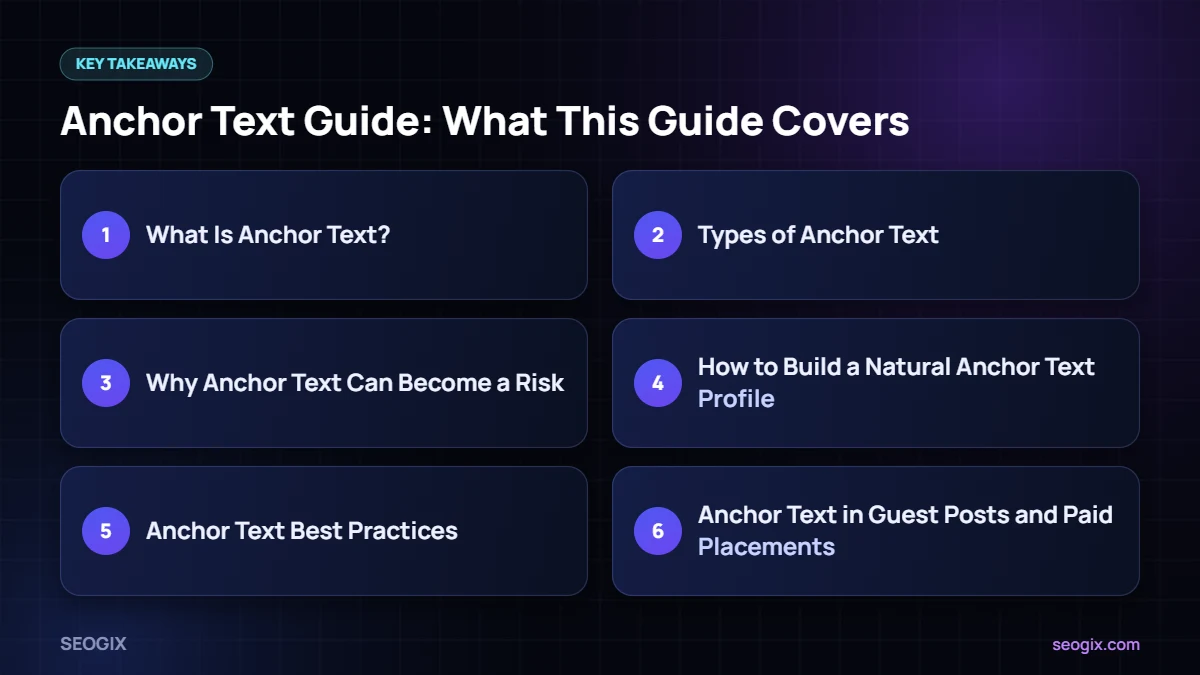
What Is Anchor Text?
In the HTML <a href="https://example.com/">best running shoes</a>, the words “best running shoes” are the anchor text. Google uses anchor text, together with the surrounding words, to understand the topic of the page being linked to. Google’s own link best practices recommend anchor text that is descriptive, reasonably concise and relevant to the page it points to.
Types of Anchor Text
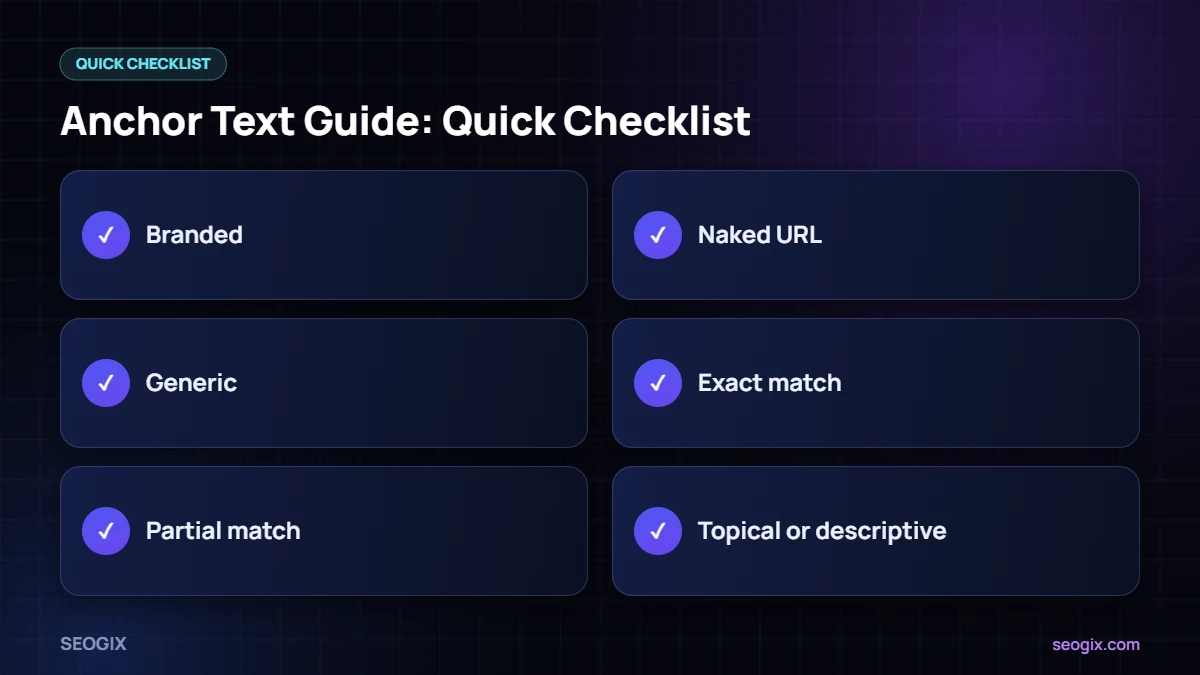
- Branded: your brand or business name, e.g. “SEOGIX”.
- Naked URL: the address itself, e.g. “seogix.com”.
- Generic: phrases like “click here”, “read more” or “this guide”.
- Exact match: the exact keyword you want to rank for, e.g. “link building service”.
- Partial match: the keyword inside a longer phrase, e.g. “our manual link building process”.
- Topical or descriptive: a natural description of the page, e.g. “a guide to choosing backlinks”.
- Image anchors: when an image is linked, the image’s alt text acts as the anchor.
Why Anchor Text Can Become a Risk
When most of a site’s backlinks use the same exact-match keyword, the profile stops looking natural. Real websites link with whatever words fit their sentence — very often your brand name or the page title. Google’s spam policies specifically mention keyword-rich anchor text in large-scale guest posting and in links inserted into articles or press releases as examples of link schemes.
The result of over-optimised anchors is usually not a dramatic penalty but links that stop helping — and, in serious cases, an unnatural links manual action.
How to Build a Natural Anchor Text Profile
There is no official “correct” percentage, and any fixed formula you read online is a rule of thumb, not a Google rule. A safer approach is to look at what ranks well in your niche and keep your profile similar. In practice, healthy profiles share a few patterns:
- Brand and URL anchors are the largest group. This is how people naturally link to a business.
- Topical and partial-match anchors come next. They describe the page without repeating one exact keyword.
- Exact-match anchors are used sparingly, mainly on the most relevant, high-quality placements.
- Generic anchors appear naturally and are not something to avoid completely.
To compare, check the anchor text reports of the top-ranking pages for your keyword in a tool such as Ahrefs or Semrush, then look at your own.
Anchor Text Best Practices
- Write for the sentence first. The anchor should read naturally inside the paragraph.
- Match the target page. The words should describe what the reader will find after clicking.
- Vary by page, not by trick. Different pages deserve different anchors; avoid rotating keyword variations just to look natural.
- Keep it concise. A few words are usually enough; whole sentences as anchors look odd.
- Use brand anchors on homepages and descriptive anchors on deep pages such as guides and service pages.
- Apply the same thinking to internal links. Descriptive internal anchors help Google understand your site structure and are low risk.
Anchor Text in Guest Posts and Paid Placements
Guest posts and paid placements are where anchor problems usually start, because the site owner controls the wording. Ask for a natural brand or descriptive anchor rather than an exact-match keyword, and remember that Google expects paid links to be marked with rel=”sponsored” or nofollow. Our guest posting guide covers how to place links safely, and our article on PBN links explains why cheap networks often push exact-match anchors.
How to Fix an Over-Optimised Profile
- Export your backlinks and group them by anchor type.
- Identify exact-match anchors on low-quality or irrelevant sites.
- Where you have contact with the publisher, ask to change the anchor to your brand name or a descriptive phrase.
- Build new links with brand and descriptive anchors to rebalance the profile over time.
- Use Google’s disavow tool only for clearly spammy links you cannot remove, especially if you have a manual action.
At SEOGIX, every link in our link building service uses a natural, context-fitting anchor and is listed in a live report so you can review the anchor text yourself.
Frequently Asked Questions
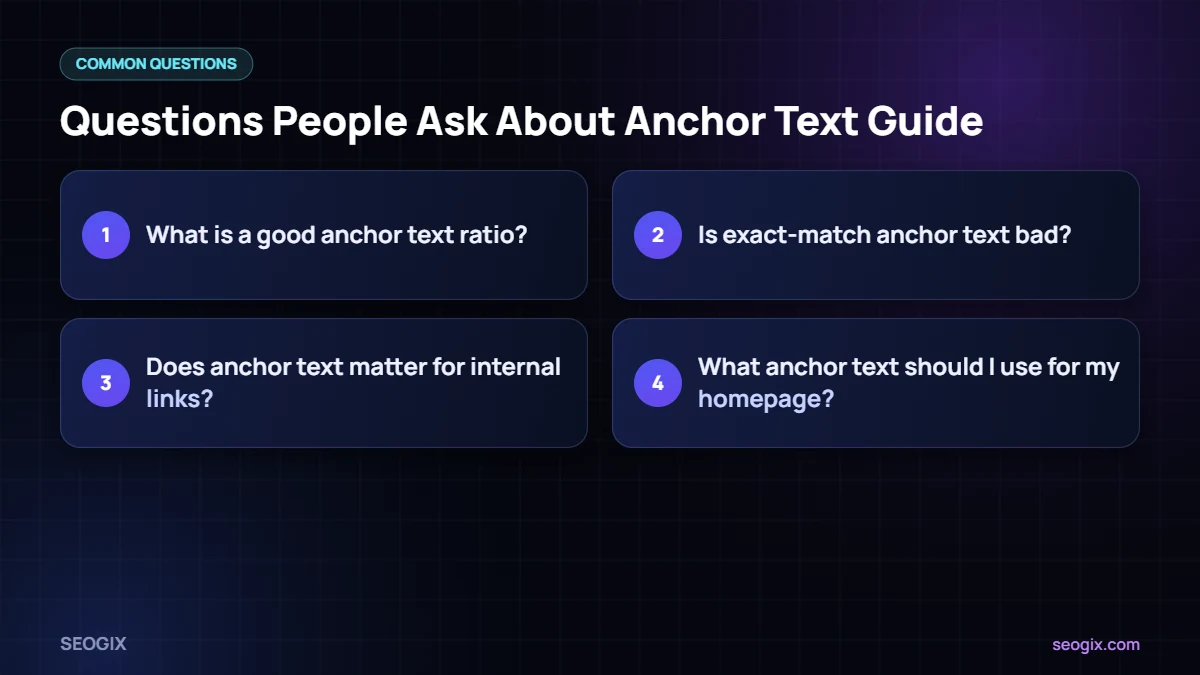
What is a good anchor text ratio?
There is no official ratio from Google. A practical approach is to keep brand, URL and descriptive anchors as the majority, use exact-match anchors sparingly, and compare your profile with the pages that already rank in your niche.
Is exact-match anchor text bad?
Not by itself. A few exact-match anchors on relevant sites are normal. The risk comes when a large share of your backlinks use the same keyword, especially from guest posts or paid placements.
Does anchor text matter for internal links?
Yes. Descriptive internal anchors help Google understand what each page is about and are a low-risk way to support your important pages.
What anchor text should I use for my homepage?
Mostly your brand name, domain name or a natural description of your business. Homepages naturally attract brand anchors.
Are “click here” anchors bad for SEO?
Generic anchors give less context than descriptive ones, so they are not ideal for important links. A few generic anchors are still a normal part of any backlink profile.