
Guest posting is one of the oldest link building methods, and it still works in 2026 — when it is done properly. You write a genuinely useful article for another website in your industry, the site publishes it, and you earn a relevant backlink plus exposure to a new audience. Done badly, it becomes a link scheme that Google is designed to ignore or penalise.
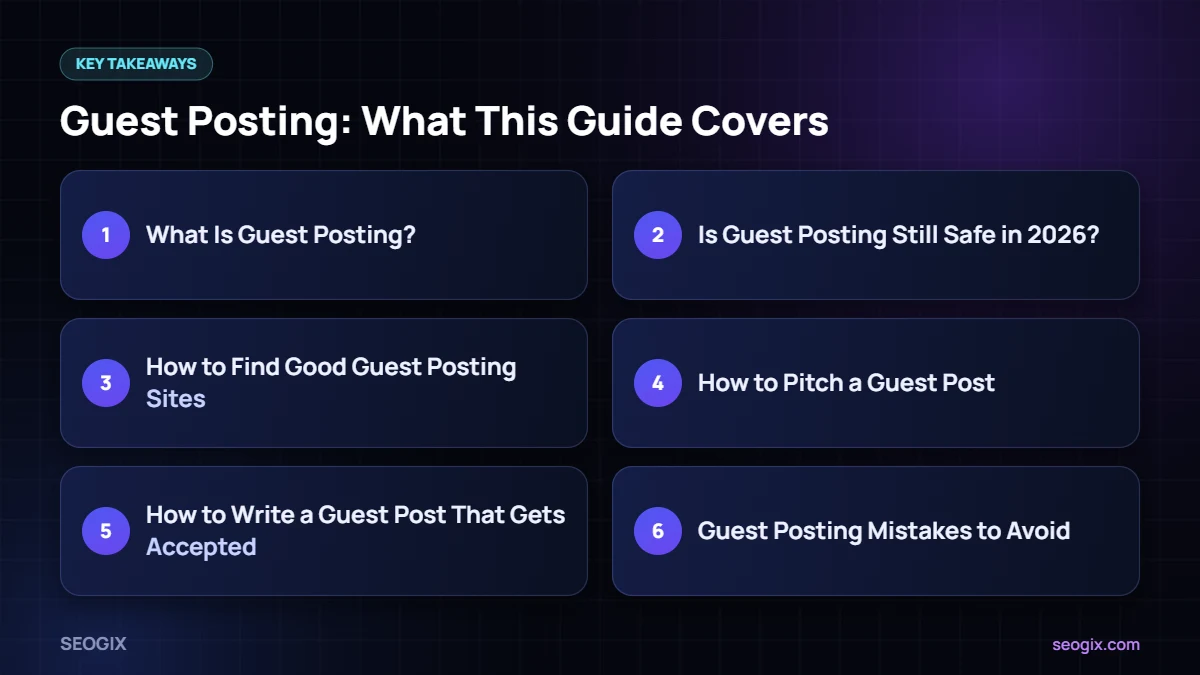
This guide explains what guest posting is, how to find sites worth writing for, how to pitch, how to write a post that gets accepted, and the mistakes that turn guest posting from an asset into a risk.
What Is Guest Posting?
Guest posting (also called guest blogging) means writing an article that is published on someone else’s website under your name or brand. In return for the content, the publisher usually allows a short author bio and one or two links back to your site.
The value comes from three places:
- A relevant backlink from a real website in your niche, which helps search engines understand and trust your site.
- Referral traffic from readers who click through to learn more about you.
- Brand authority — being published on respected sites makes your business look credible to clients and partners.
Is Guest Posting Still Safe in 2026?
Yes, with one important condition: the article must exist for readers, not for links. Google’s spam policies list “large-scale article marketing or guest posting campaigns with keyword-rich anchor text links” as an example of a link scheme. In other words, Google is not against guest posts — it is against mass-produced guest posts written only to plant exact-match links.
A safe guest post looks like normal editorial content: it is written for that site’s audience, it is published on a site with real readers, and the link to you is natural and genuinely useful.
How to Find Good Guest Posting Sites
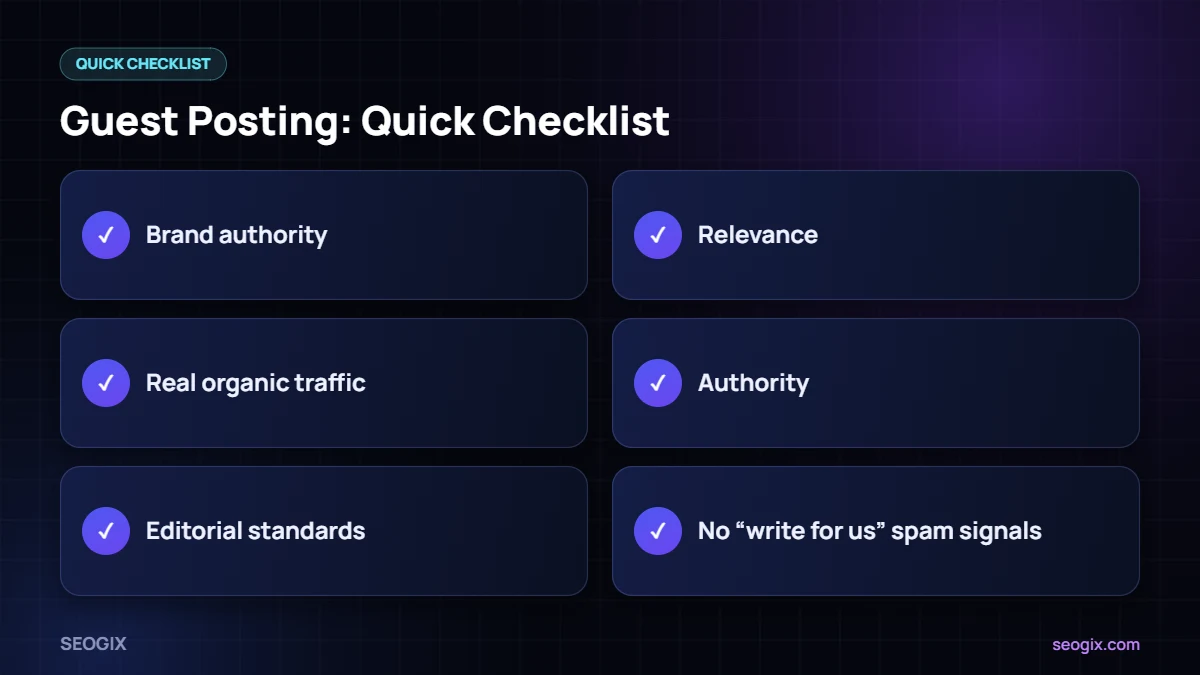
The quality of the website matters more than any single metric. Before you pitch, check each site against this list:
- Relevance. The site covers your industry or a closely related topic. A link from a relevant site is worth far more than one from a random high-DR blog.
- Real organic traffic. Use a tool such as Ahrefs or Semrush to confirm the site ranks for real keywords and is not losing traffic fast.
- Authority. Check Domain Rating or Domain Authority with our free SEO tools. Treat it as a filter, not the goal — see what Domain Rating really means.
- Editorial standards. Read a few recent posts. If every article is thin, off-topic or stuffed with casino and loan links, walk away.
- No “write for us” spam signals. Sites that openly sell links on every page, show no author names, or publish dozens of unrelated guest posts a day are usually link farms.
Useful search operators for finding opportunities include your topic + "write for us", your topic + "guest post" and your topic + "contribute". Then filter the results with the checklist above.
How to Pitch a Guest Post
Editors receive many pitches every week. A short, personal pitch stands out. A good pitch:
- Uses the editor’s name and mentions a specific article on their site.
- Suggests two or three topic ideas that fit their audience and are not already covered.
- Explains in one sentence why you are qualified to write about it.
- Links to one or two samples of your best writing.
- Stays under 150 words.
Avoid template pitches sent to hundreds of sites — editors spot them instantly, and they rarely lead to placements on sites worth having.
How to Write a Guest Post That Gets Accepted
1. Follow the site’s guidelines
Respect word count, formatting, image rules and link limits. Ignoring guidelines is the fastest way to get rejected.
2. Write for their readers, not for your link
Answer a real question in depth, add examples, data you can source, and practical steps. The better the article, the longer it stays live and the more it is read.
3. Place your link naturally
Link to a page that genuinely adds value for the reader — a guide, a tool or a resource — rather than forcing a link to a sales page. Use natural anchor text such as your brand name or a descriptive phrase. Our anchor text guide explains how to choose anchors safely.
4. Keep the author bio short
One or two sentences about who you are and one link is enough. Many editors remove bios that read like advertisements.
Guest Posting Mistakes to Avoid
- Exact-match anchor text in every post. This is the classic pattern Google’s link spam systems look for.
- Publishing on networks of low-quality sites. Many “guest post sites” are really private blog networks — read why PBN links are risky.
- Spinning or duplicating articles. Each post should be original and written for that site.
- Chasing metrics only. A high-DR site with no traffic and no relevance adds little value.
- Forgetting to track. Keep a sheet of live URLs, anchors, dates and target pages so you can check links stay live.
Should You Do Guest Posting Yourself or Outsource It?
Doing it yourself gives you full control but takes time: research, outreach, writing, follow-ups and tracking can easily take several hours per placement. Outsourcing makes sense when you need consistent placements on vetted, relevant sites.
At SEOGIX, our guest posting service places editorial posts on real, relevant blogs with natural anchors and a live report for every link. If you want a wider mix of placements, see our link building service.
Frequently Asked Questions
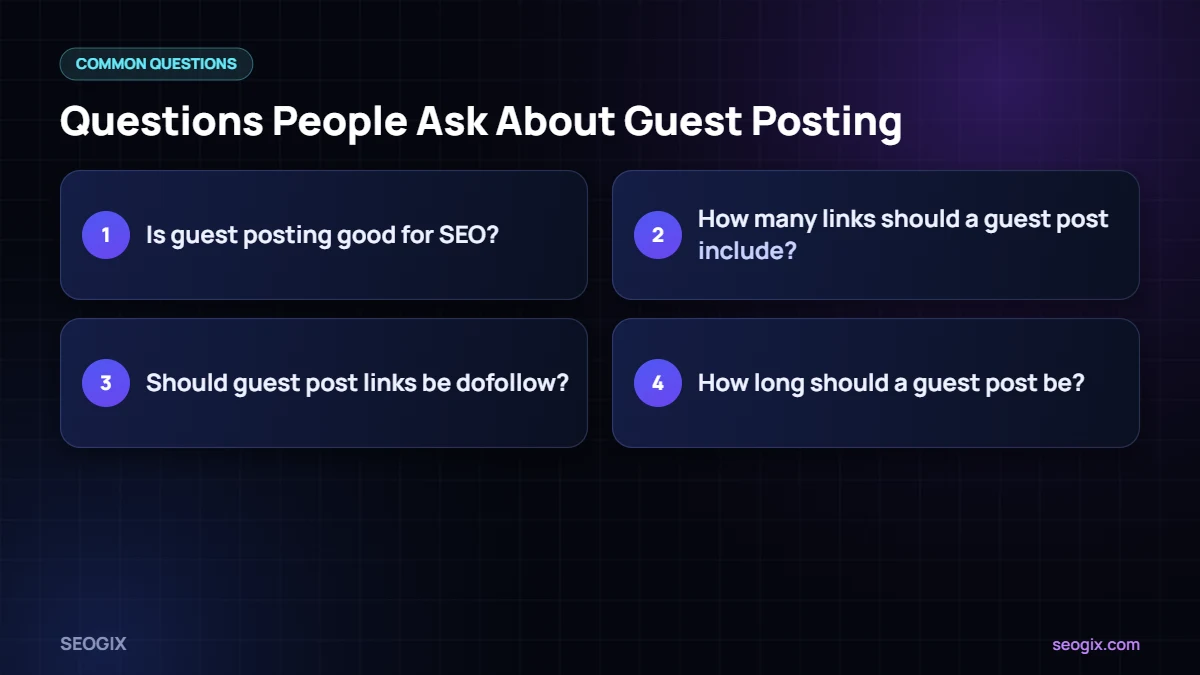
Is guest posting good for SEO?
Yes, when the post is published on a relevant site with real readers and the link is natural. It builds relevant backlinks, referral traffic and brand trust. Mass guest posting with keyword-rich anchors is treated as a link scheme.
How many links should a guest post include?
Usually one link to your site is enough, either in the body or the author bio. Many publishers allow one or two. More than that starts to look promotional.
Should guest post links be dofollow?
Many editorial guest post links are followed, but some publishers mark them as nofollow or sponsored. If you paid for the placement, Google expects the link to be marked rel=”sponsored” or nofollow.
How long should a guest post be?
Follow the publisher’s guidelines. In practice, most quality guest posts are long enough to fully answer the topic — often 1,000 words or more — but depth matters more than word count.
How do I know if a guest posting site is good?
Check relevance, real organic traffic, editorial quality and whether the site openly sells links on every page. Authority metrics like DR or DA are useful filters but should not be the only check.