AI in digital marketing is no longer only for big brands with data science teams. Small businesses now use AI every day to write first drafts, plan campaigns, analyse results and answer customer questions. The key is knowing where AI saves time and where a human still needs to lead.
Here are 12 practical uses of AI in digital marketing, with honest notes on the limits.
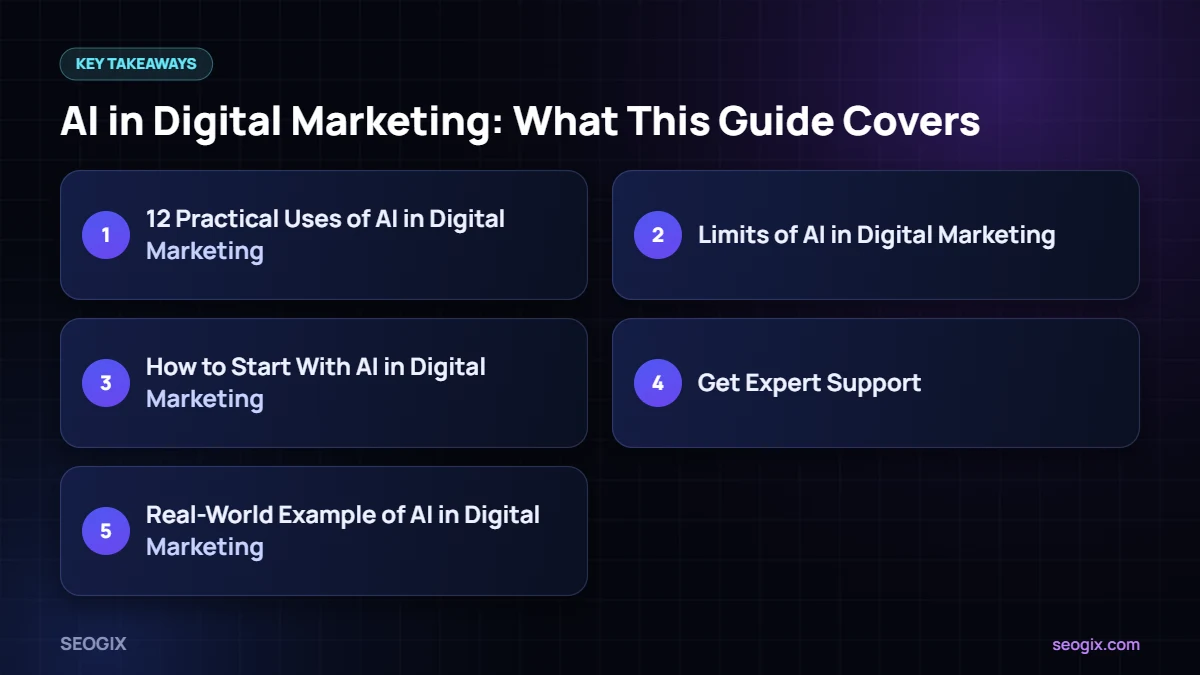
12 Practical Uses of AI in Digital Marketing
1. Content planning
Use AI to brainstorm blog topics, social post ideas and campaign themes based on your audience and season.
2. First drafts
AI can draft emails, product descriptions, ad copy and blog outlines. A person should edit for accuracy, brand voice and real experience.
3. SEO research
AI helps group keywords, suggest questions and draft content briefs. Validate everything with real search data — see our guide on ChatGPT for keyword research.
4. Ad variations
Generate multiple headline and description options for testing. Platforms such as Google Ads also use AI to mix and match assets.
5. Email personalisation
AI tools in email platforms suggest subject lines, send times and segments based on past behaviour.
6. Social media captions
Draft captions, hashtags and post variations for different platforms, then adjust them to sound like you.
7. Image and design ideas
AI image tools can create concepts and mock-ups. Check usage rights and avoid misleading images of real products or people.
8. Customer support
AI chatbots can answer common questions on your website and route complex issues to a person.
9. Analytics summaries
Ask AI to explain trends in your reports in plain language, then confirm the conclusions with the actual data.
10. Competitor research
Summarise competitor pages, offers and reviews to spot gaps in your own marketing.
11. Translation and localisation
AI speeds up translation, but a native speaker should review anything customer-facing.
12. Repurposing content
Turn one detailed blog post into social posts, an email, a short video script and an FAQ section.
Limits of AI in Digital Marketing
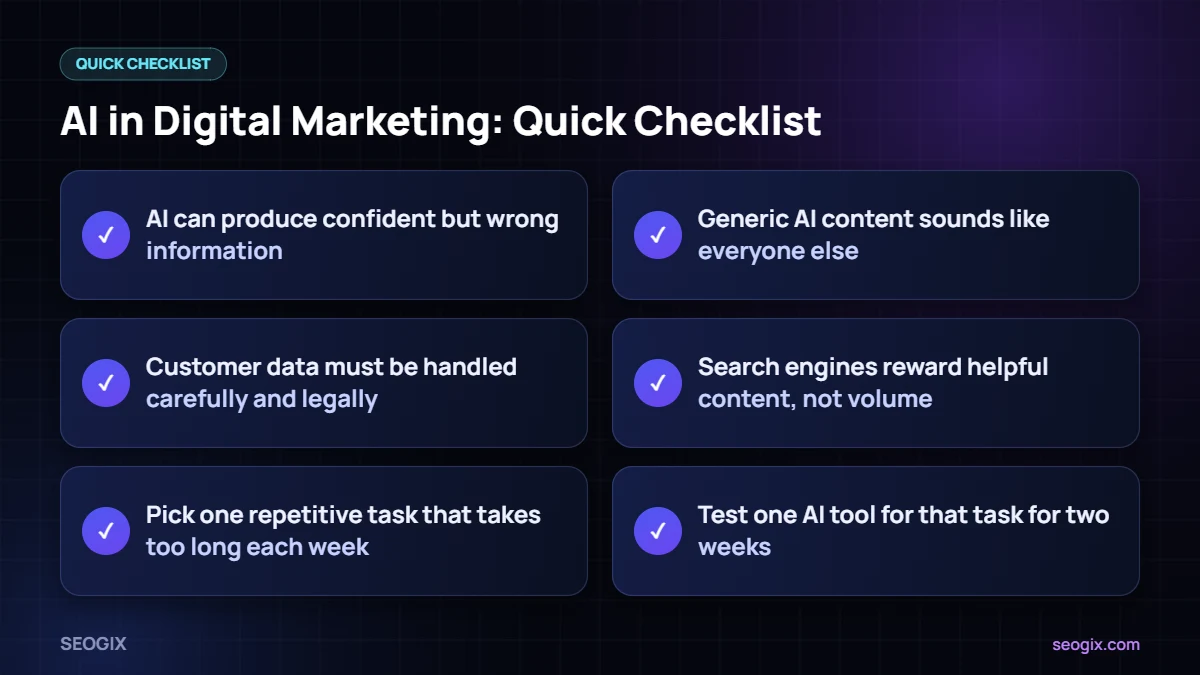
- AI can produce confident but wrong information.
- Generic AI content sounds like everyone else.
- Customer data must be handled carefully and legally.
- Search engines reward helpful content, not volume — Google advises fact-checking AI content before publishing in its generative AI guidance.
How to Start With AI in Digital Marketing
- Pick one repetitive task that takes too long each week.
- Test one AI tool for that task for two weeks.
- Create a short checklist for reviewing the output.
- Measure time saved and results.
- Expand to the next task only when the first one works well.
Get Expert Support
At SEOGIX we use AI to work faster while keeping humans in charge of strategy, accuracy and quality. Explore our content writing and local SEO services, or read does Google penalize AI content.
Real-World Example of AI in Digital Marketing
A local clothing boutique uses AI in digital marketing in three small ways. Every Monday, the owner asks an assistant for five Instagram caption ideas based on the week’s new arrivals and rewrites the best two in her own voice. Before each sale, she uses AI to draft three email subject lines and tests them with her email platform. At the end of the month, she pastes her analytics summary into an assistant and asks which posts drove the most website visits.
The tools save her a few hours each week, but she still takes the photos, chooses the products and replies to every customer message herself. That balance — AI for speed, people for judgement and relationships — is where AI in digital marketing works best for small businesses.
Frequently Asked Questions
How is AI used in digital marketing?
For content drafts, research, ad testing, email personalisation, chatbots, analytics summaries and repurposing content.
Will AI replace digital marketers?
AI replaces some repetitive tasks, but strategy, creativity, relationships and judgement still need people.
Is AI marketing expensive?
Many useful AI features are free or included in tools you already use. Start small and pay only when a tool clearly saves time.
What is the biggest risk of AI in marketing?
Publishing inaccurate or generic content without review. Always check facts and edit for your brand.