ChatGPT will not tell you exact search volumes, and it can invent numbers if you ask. But using ChatGPT for keyword research is still incredibly useful for brainstorming ideas, understanding intent and organising large lists. The trick is to use it for thinking, then validate with real data.
Here are seven smart prompts for using ChatGPT for keyword research, and a simple process to check the results.
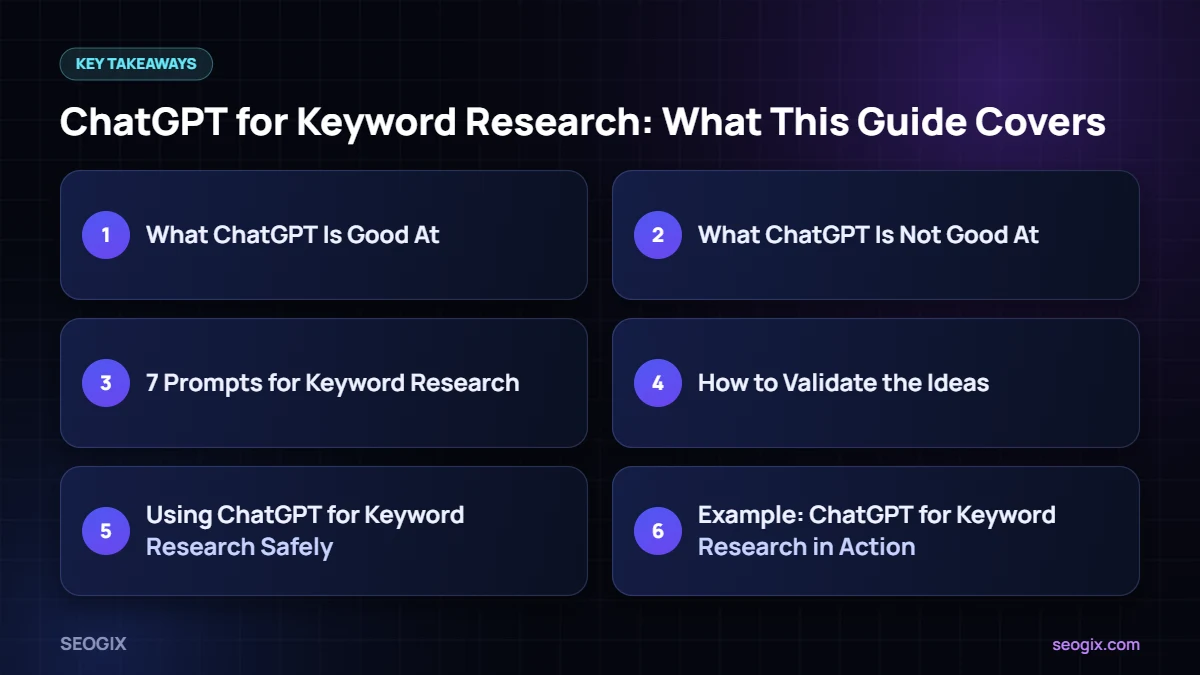
What ChatGPT Is Good At
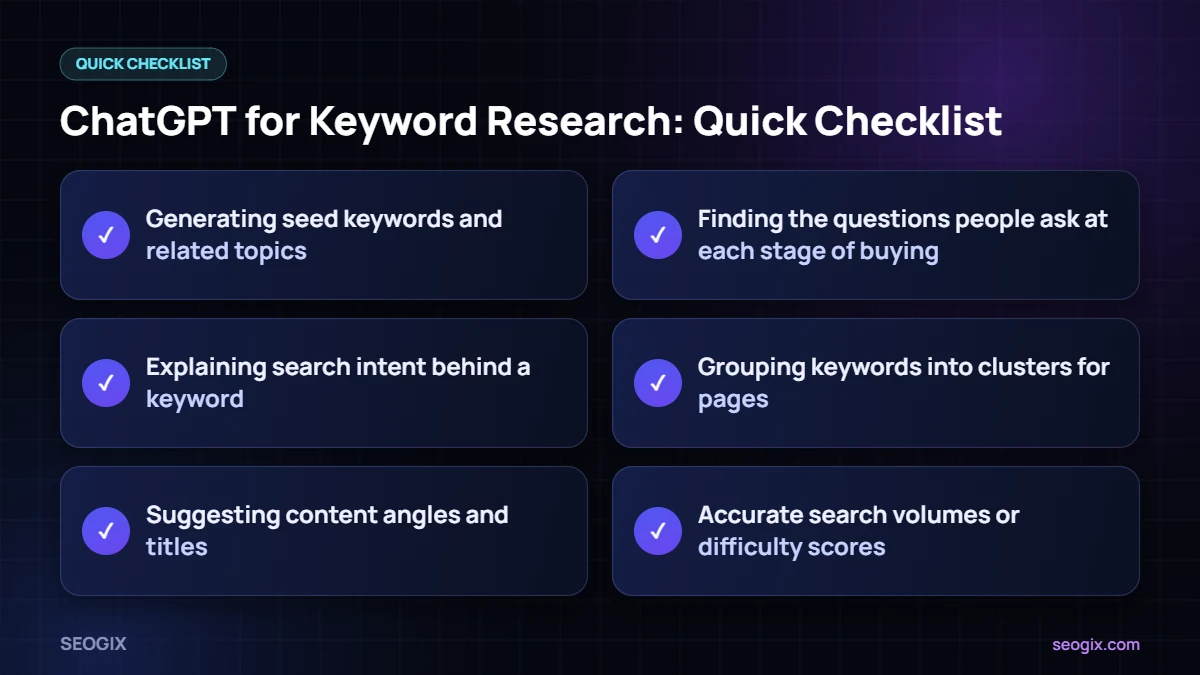
- Generating seed keywords and related topics.
- Finding the questions people ask at each stage of buying.
- Explaining search intent behind a keyword.
- Grouping keywords into clusters for pages.
- Suggesting content angles and titles.
What ChatGPT Is Not Good At
- Accurate search volumes or difficulty scores.
- Knowing what currently ranks in your market.
- Local trends it has no data for.
For volumes, use a tool such as Google Keyword Planner, Ahrefs or Semrush, and Google Search Console for your own data.
7 Prompts for Keyword Research
1. Seed ideas
“I run a [business] in [city] that offers [services]. List 40 search phrases potential customers might use, grouped by service.”
2. Customer questions
“List the questions someone asks before hiring a [service provider], grouped into early research, comparison and ready to buy.”
3. Problem-based searches
“What problems make people search for [product or service]? Write each as a search query.”
4. Search intent
“For each keyword in this list, label the likely intent as informational, commercial, transactional or navigational, and suggest the best page type.”
5. Clustering
“Group these keywords into clusters where one page could target each cluster. Name each cluster and choose a main keyword.” Paste your exported list below the prompt.
6. Content gaps
“Here are the headings from the top three pages for [keyword]. What subtopics are missing that a beginner would want answered?”
7. Local variations
“List neighbourhoods, landmarks and local terms people in [city] use when searching for [service].” Always confirm local terms with real searches.
How to Validate the Ideas
- Export ChatGPT’s list into a spreadsheet.
- Check volume and difficulty in a keyword tool with the right location.
- Search the top keywords yourself to confirm intent.
- Check Search Console to see which ideas already bring impressions.
- Remove terms with no demand or the wrong intent.
- Map the final keywords to pages.
Google’s Keyword Planner help explains how to get location-specific estimates.
Using ChatGPT for Keyword Research Safely
Treat every number ChatGPT gives as a guess unless it comes from a connected data source you trust. Use its strength — fast, creative thinking — and let real data make the final decision.
For a wider view of AI in SEO, read our guides on AI SEO and AI SEO tools.
Example: ChatGPT for Keyword Research in Action
Here is how a small bakery in Islamabad might use ChatGPT for keyword research in about thirty minutes.
- They ask for search phrases customers might use and get a list including “custom birthday cake Islamabad”, “eggless cake delivery”, “cupcakes for office party” and “wedding cake price”.
- They ask for customer questions and get ideas like “how far in advance should I order a wedding cake?” and “can you deliver cakes on the same day?”.
- They paste the combined list into Keyword Planner with Islamabad as the location and remove phrases with no searches.
- They search the top ten phrases on Google. Several show a map pack, so they focus on their Google Business Profile and service pages for those.
- Question-style phrases become a FAQ section and two blog posts.
The result is a realistic keyword plan built from real demand, with ChatGPT for keyword research doing the creative heavy lifting and real tools confirming what is worth targeting.
Common Mistakes When Using ChatGPT for Keyword Research
- Trusting search volumes it makes up.
- Creating separate pages for every small variation of the same idea.
- Ignoring local language, spellings and slang.
- Skipping the step of checking what actually ranks.
Frequently Asked Questions
Can ChatGPT replace keyword tools?
No. It is great for ideas and organisation, but it does not provide reliable search volumes or ranking data.
Is ChatGPT keyword research accurate?
The ideas are often useful, but always validate demand and intent with real data before creating content.
What is the best prompt for keyword research?
Give context about your business, audience and location, ask for grouped results, and ask follow-up questions to go deeper.
Can ChatGPT find long-tail keywords?
Yes, it is good at suggesting specific questions and long-tail phrases. Check which ones people actually search.