Every time your business name, address and phone number appear on another website, that mention is called a citation. Local citations help Google confirm that your business is real, where it is located and how people can contact it. They also help customers find you on directories they already trust.
This guide explains how local citations work, which ones matter most, and seven essential steps to build and clean them up.
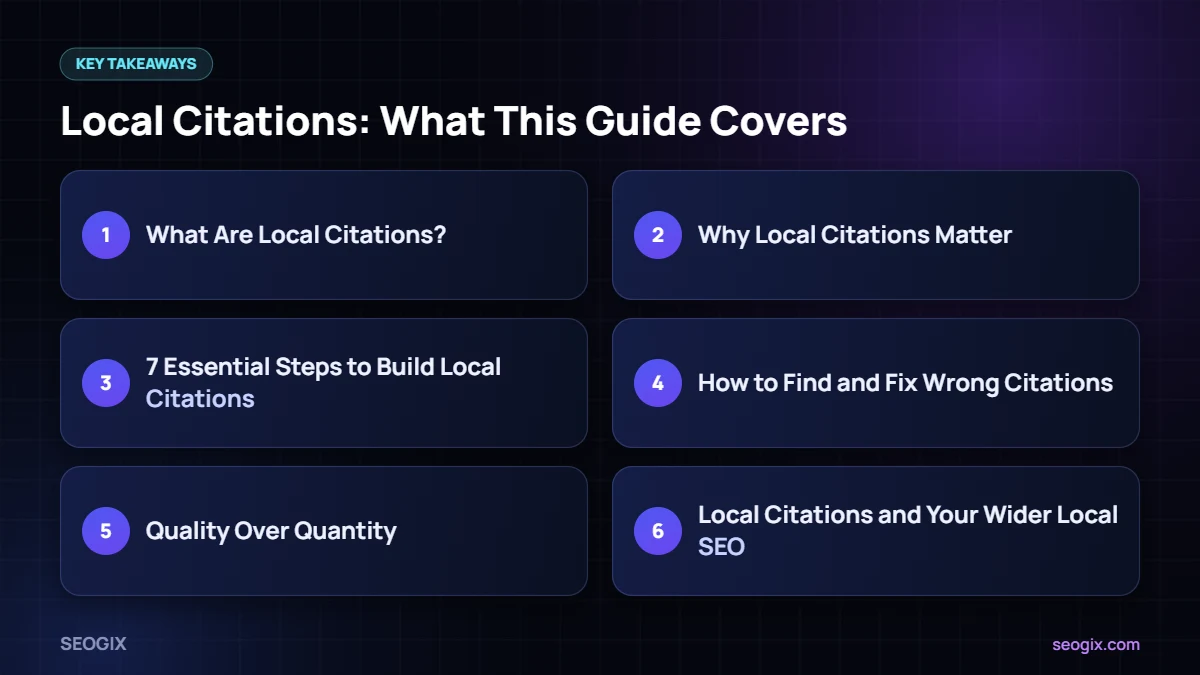
What Are Local Citations?
A citation is any online mention of your business details, usually your name, address and phone number (often shortened to NAP). Many also include your website, opening hours, categories and photos.
Structured citations
These appear in business directories and platforms with fixed fields, such as Google Business Profile, Bing Places, Apple Business Connect, Yelp, Facebook and industry directories.
Unstructured citations
These are mentions in normal content — a local news article, a blog post, an event page or a supplier’s list of partners.
Why Local Citations Matter
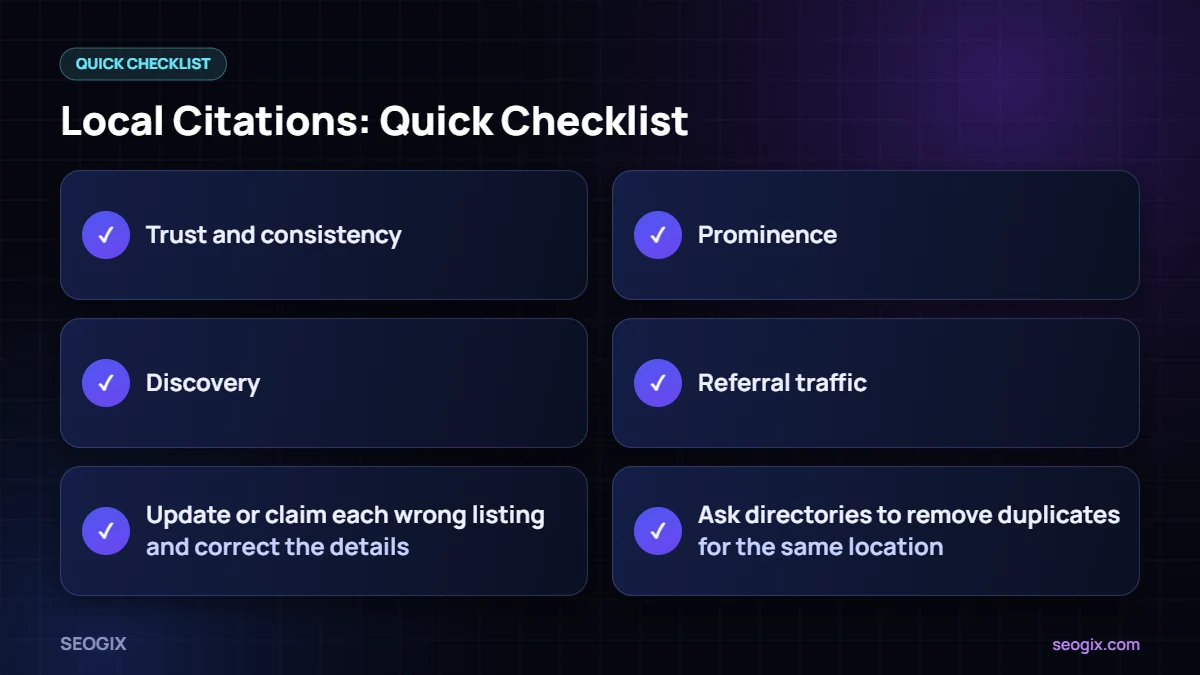
- Trust and consistency: matching details across the web make it easier for search engines to trust your information.
- Prominence: Google describes prominence as information it has about a business from across the web, including links, articles and directories.
- Discovery: customers search directories, maps and apps beyond Google.
- Referral traffic: some niche directories send real enquiries.
Local citations are not a magic ranking button, but inconsistent or wrong details can confuse both customers and search engines. You can read how Google describes prominence in its local ranking guide.
7 Essential Steps to Build Local Citations
1. Decide your official NAP
Write down one exact version of your business name, address and phone number. Use the same format everywhere, including suite numbers and abbreviations.
2. Start with the core platforms
Claim Google Business Profile, Bing Places, Apple Business Connect and Facebook first. These are used by maps, voice assistants and many apps.
3. Add major general directories
List your business on the leading general directories in your country. In Pakistan, the UK, the US and other markets the main directories differ, so check which ones rank for searches like “plumber in [city]”.
4. Add industry and niche directories
Lawyers, doctors, restaurants, hotels, tradespeople and software companies all have specialist directories. These local citations are often more valuable than generic ones because they are relevant to your industry.
5. Look for local sources
Chambers of commerce, business associations, local news sites, city portals and community groups often list member businesses.
6. Complete every profile fully
Add your website, hours, categories, description, logo and photos. A complete listing is more useful to customers and less likely to be edited by others.
7. Keep a citation tracker
Record every listing in a spreadsheet: site name, URL, login email, date created and the NAP used. This makes future updates much easier.
How to Find and Fix Wrong Citations
- Search Google for your business name with old addresses or phone numbers.
- Search for your phone number on its own to find listings you forgot.
- Use a citation tool such as BrightLocal, Whitespark or Semrush Listing Management if you have many locations.
- Update or claim each wrong listing and correct the details.
- Ask directories to remove duplicates for the same location.
Moving premises or changing phone numbers is the most common reason local citations go out of date, so run this check after any change.
Quality Over Quantity
Hundreds of low-quality directory listings do not help. Focus on platforms that real customers use, directories that rank in Google for your services, and sources related to your industry or city. Avoid sites that look like spam farms or exist only to sell listings.
Local Citations and Your Wider Local SEO
Local citations work best together with a strong Google Business Profile, steady reviews and a well-structured website. Our Google Business Profile guide covers the profile side, and our local SEO service can build and clean up citations for you. For general link opportunities, see our list of free backlink sites.
Common Local Citations Mistakes
- Using different business names. “SEOGIX”, “Seogix SEO Agency” and “SEOGIX Pvt Ltd” on different sites look like three businesses.
- Call-tracking numbers everywhere. If you use tracking numbers, keep your main number as the primary one on core listings.
- Ignoring duplicates. Two listings for the same address split reviews and confuse customers.
- Paying for bulk submissions. Cheap packages that promise hundreds of local citations often use low-quality sites you cannot later edit.
- Forgetting old addresses. After a move, old listings can keep sending customers to the wrong place for years.
How Long Do Local Citations Take to Work?
Most directories publish new listings within a few days to a few weeks, and some data aggregators take longer to pass details on to the apps and sites they supply. Expect to see the full benefit of new local citations over a few months, not overnight. The best time to start is before you launch a new location or move premises, so that your details are correct everywhere from day one.
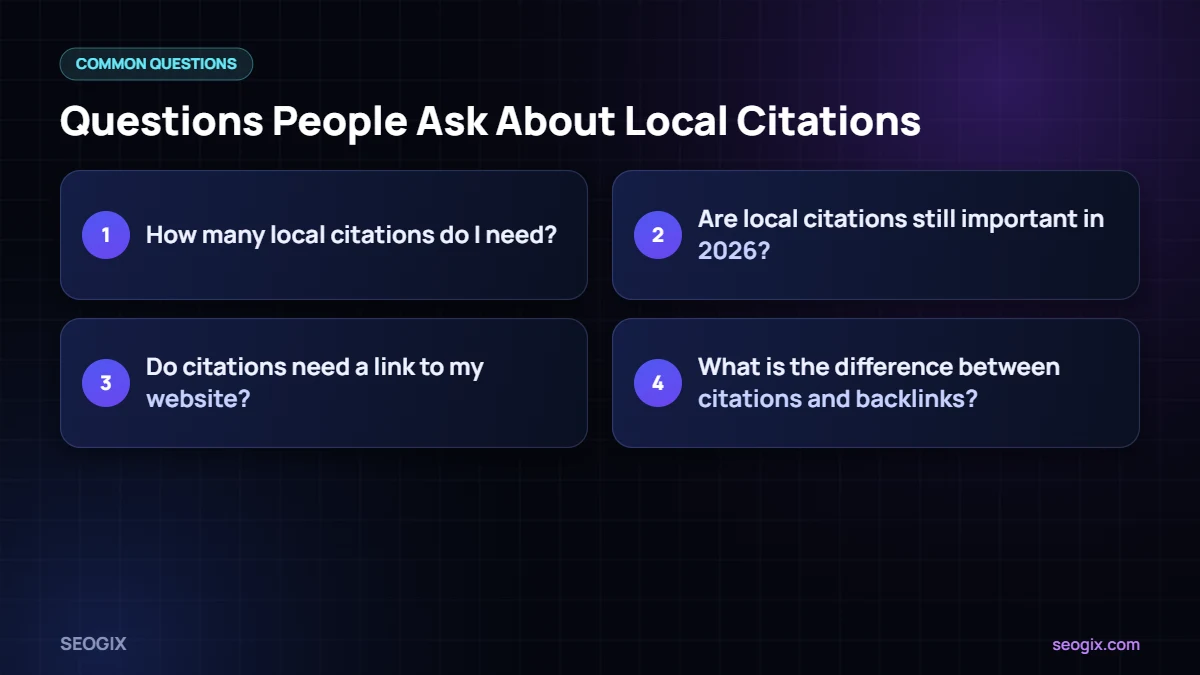
Frequently Asked Questions
How many local citations do I need?
There is no fixed number. Aim to be listed on the main platforms, the top directories in your country, and the leading sites in your industry and city, with consistent details everywhere.
Are local citations still important in 2026?
Yes, especially for consistency and trust. They are not a shortcut to rankings on their own, but wrong or conflicting details can hurt how customers and search engines see your business.
Do citations need a link to my website?
No. A citation counts even without a link. Links are a bonus because they can send traffic and help your website.
What is the difference between citations and backlinks?
A citation is a mention of your business details. A backlink is a clickable link to your website. Many directory listings provide both.