A content brief tells a writer exactly what to create: who it is for, what it must cover, which keyword it targets and how success will be measured. Good briefs lead to better articles and fewer rewrites. An AI content brief uses AI to gather and organise much of this information quickly, so the strategist can spend time on the parts that need real judgement.
This guide shows what to include in an AI content brief, a reusable template and how to keep the human insight that makes content stand out.
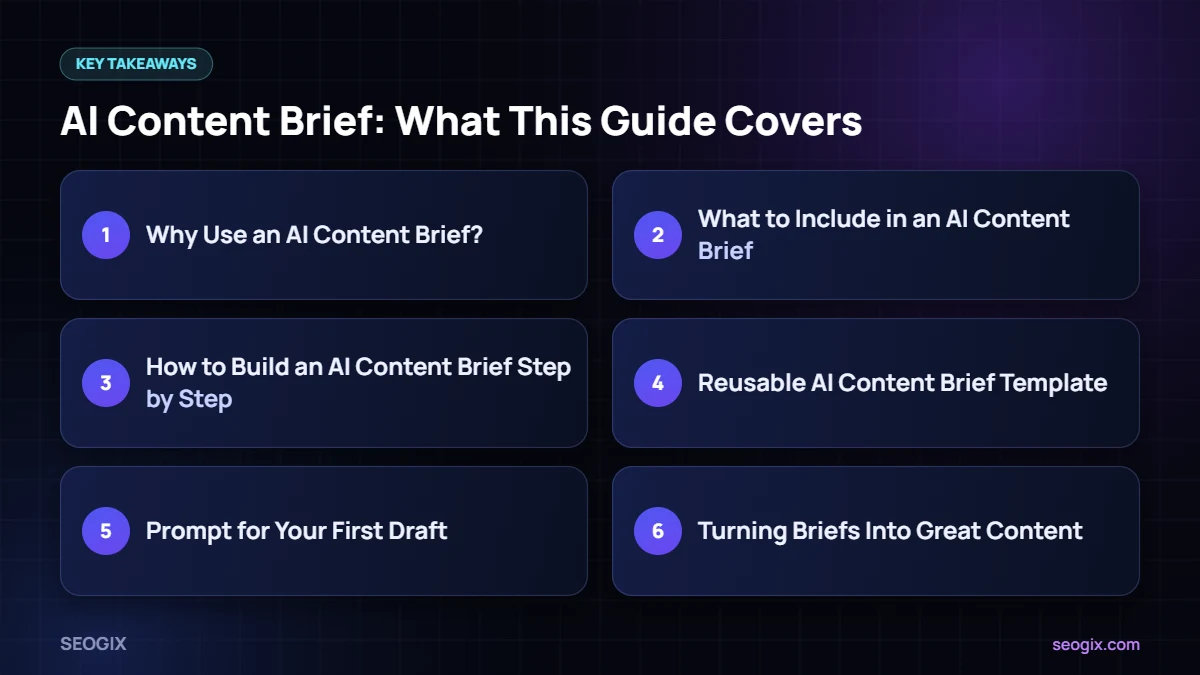
Why Use an AI Content Brief?
- Speed: AI can summarise competitor pages, list questions and suggest outlines in minutes.
- Consistency: every writer gets the same structure and information.
- Coverage: AI helps spot subtopics and questions you might miss.
The risk is that every AI-generated brief starts to look the same, which leads to content that looks like everything else on page one. The human layer fixes that.
What to Include in an AI Content Brief
- Target keyword and close variations.
- Search intent: what the searcher wants to achieve.
- Audience: who they are and what they already know.
- Goal: the action you want readers to take.
- Suggested title and meta description.
- Outline: H2s and H3s in a logical order.
- Questions to answer: from People also ask, forums and customer calls.
- Unique angle: what you will add that competitors do not have.
- Sources and data: primary sources to cite.
- Internal links: pages to link to and from.
- Word count range and format notes.
How to Build an AI Content Brief Step by Step
1. Collect real data first
Gather the keyword data, the top-ranking URLs and your Search Console queries. AI works better with real inputs.
2. Ask AI to summarise the top results
Paste the headings of the top pages and ask for common themes and gaps.
3. Generate an outline
Ask for a logical outline that matches the search intent. Remove sections that do not serve the reader.
4. Add the human insight
This is the most important step. Add your own experience, examples, data, opinions and customer questions. This is what Google describes as experience and expertise, and it is what AI cannot invent.
5. Check facts and sources
Replace any AI-suggested statistics with real, linked sources. Google’s generative AI content guidance stresses fact-checking before publishing.
6. Finalise and share
Keep the brief to one or two pages so writers actually read it.
Reusable AI Content Brief Template
- Keyword:
- Intent:
- Audience:
- Goal / CTA:
- Title options:
- Meta description:
- Outline (H2/H3):
- Must-answer questions:
- Our unique angle / experience:
- Sources to cite:
- Internal links:
- Length and format:
Prompt for Your First Draft
“Create a content brief for the keyword [keyword]. Audience: [audience]. Goal: [goal]. Here are the headings from the top 3 results: [paste]. Suggest an outline, questions to answer and 3 title options. Do not invent statistics.”
Turning Briefs Into Great Content
A strong AI content brief is only the start. The writer still needs to bring clarity, examples and voice. Our content writing service combines efficient briefs with expert writers. For more on AI and SEO, read does Google penalize AI content.
Example: An AI Content Brief in Practice
Here is a short example of how an AI content brief for the keyword “how to choose a web hosting provider” might look after human review.
- Audience: small business owners launching their first website.
- Intent: informational, leading to a comparison or recommendation.
- Goal: help readers choose confidently and invite them to request a free website consultation.
- Outline: what hosting is; types of hosting; key factors (speed, support, security, backups, price); red flags; a simple decision checklist; FAQs.
- Unique angle: real speed tests from three client sites we moved last year, with screenshots.
- Sources: official provider documentation and Google’s page experience guidance.
- Internal links: technical SEO checklist and WordPress SEO guide.
Notice that the most valuable line is the unique angle. AI suggested the outline in seconds, but only the team could add real speed tests from client sites. That single addition makes the final article worth reading and worth linking to.
Common AI Content Brief Mistakes
- Accepting the first outline without checking search intent.
- Leaving AI-suggested statistics in the brief without sources.
- Forgetting to say what the reader should do next.
- Writing briefs so long that writers skip them.
Frequently Asked Questions
Can AI write the whole content brief?
AI can draft most of it, but a strategist should add the unique angle, real experience and verified sources.
How long should a content brief be?
One to two pages is usually enough. Longer briefs often go unread.
Do content briefs improve SEO?
Yes. Clear briefs help writers match search intent, cover the topic fully and link to the right pages.
Which tools create AI content briefs?
General assistants like ChatGPT, Claude and Gemini work well with good prompts, and many SEO platforms now include brief generators.